Nowadays, launching a website is easier than ever, and it can be created with just a few simple steps. But can every website succeed in this competitive environment? Success depends on various factors, one of the most important being web hosting. You might think hosting is not that important, but that’s a misconception. Whether you run a simple blog, a corporate website, or even an online store, choosing the right hosting solution is essential.
What Is Web Hosting?
Have you ever wondered how a website remains accessible at any time of the day? Web hosting is a service that allows your website’s data and files to be stored on a server provided by a hosting company. This server is continuously powered on and connected to the internet. Whenever a user visits your website, the server delivers the website’s content directly to their browser, allowing them to view and interact with your site.
Main Components of a Web Hosting Service:
- Server
- Domain Name
- Control Panel
The Importance of Choosing a Host
As you now know, web hosting ensures that your website remains accessible to users 24/7. The type of hosting you choose also affects your website’s performance, scalability, user experience, and more. Therefore, choosing the right hosting service is extremely important and should be done carefully. Some of the key factors to consider before purchasing a hosting plan include:
- Loading Speed: The faster your website loads, the better the user experience will be, and the more likely it is to achieve improved SEO performance.
- Uptime: If your website is not always available, you will lose users. Therefore, it is better to choose a hosting provider with high uptime.
- Security: Another important factor when choosing a hosting service is security. The hosting should support security standards and measures.
- Scalability: Your website won’t always stay at its current level — it will grow and improve over time. Therefore, choose a host that offers scalable resources.
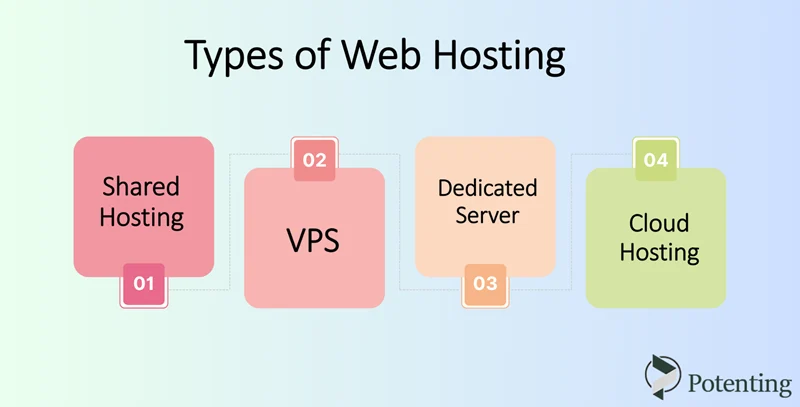
Types of Web Hosting
There are different types of hosting, each suitable for specific types of businesses and different needs. To find out which hosting is right for you, stay with us.
Shared Hosting
To better understand shared hosting, imagine a large house. This house has many rooms, but all of them share a single kitchen and bathroom. Of course, this can become crowded and frustrating.
Shared hosting is also a single server whose resources are allocated to multiple users without clear separation. This means that if one user consumes a large amount of resources, other websites may experience performance issues.
This type of hosting is suitable for small websites with a low budget, but it is not recommended.
Websites That Use Shared Hosting:
- Small websites
- Personal blog
- Newly established businesses
Advantages of Shared Hosting:
- Very low cost
- Managed by the provider
- Includes a control panel and free SSL certificate
Challenges of Shared Hosting:
- Limited scalability
- Performance drops under high traffic
- Low speed
Virtual Private Server (VPS)
To explain this type of hosting, we can also use the house example. Imagine living in an apartment building where you have several neighbors. You have all the necessary facilities within your own unit, and you are not required to share them with others, but the land and infrastructure of the building are shared.
In a virtual server, the resources of a single physical server are divided using virtualization technology and provided to multiple users. However, unlike shared hosting, each user can only use the resources that have been allocated to them.
Websites That Use VPS:
- Growing websites
- Developers
- Low-traffic online stores
Advantages of VPS:
- Dedicated resources
- High scalability
- Available in both managed and unmanaged plans
Challenges of VPS:
- Higher cost compared to shared hosting
- The user is responsible for server management
Dedicated Server
If we consider this type of hosting as a house, it would be a large, standalone villa with only one owner. In a dedicated server, an entire server with all its resources is allocated to a single user.
Websites That Use Dedicated Server:
- Corporate websites
- High-traffic online stores
- Companies and websites requiring high security
Advantages of Dedicated Server:
- High security
- Fully dedicated resources
- Best level of performance
- Full control over the server
Challenges of Dedicated Server:
- High cost
- Requires technical expertise for management
Cloud Hosting
A cloud hosting system consists of multiple interconnected servers. This type of hosting offers very high scalability and stability. If a problem occurs on one server, users will not notice it at all, because the other servers remain active and keep the service running.
Websites That Use Cloud Hosting:
- High-traffic websites
- SaaS platforms
- Applications requiring scalability
Advantages of Cloud Hosting:
- Distributed resources across a network
- Very high stability
- Flexible payment options
Challenges of Cloud Hosting:
- Complex pricing structure
- Requires technical knowledge for configuration
Share of hosting usage types in global websites
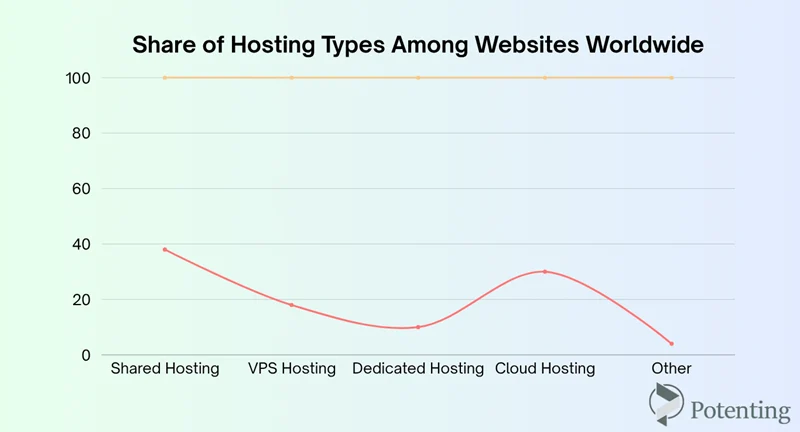
Why is shared hosting so widely used around the world even though it is not a suitable option for most businesses?
As mentioned, this type of hosting is suitable for small websites with low traffic. There are millions of websites online that do not receive high traffic, and their owners use shared hosting to reduce costs. On the other hand, people who run personal blogs also mostly use this type of hosting.
Common mistakes in choosing the right hosting
Some of the most common mistakes users make when selecting a hosting service include:
- Choosing only based on price and ignoring the website’s needs
- Not considering important factors such as scalability
- Failing to choose a provider with good support
- Not anticipating future business growth
If you pay attention to these factors when choosing a hosting service, you will most likely make a good decision and achieve significant growth.
Finally
In conclusion, web hosting is one of the most fundamental elements behind every successful website. No matter how well-designed or valuable your content is, without reliable hosting your website cannot perform effectively or remain consistently accessible to users. Understanding different hosting types and carefully evaluating your website’s needs will help you make a smarter decision, improve performance, and ensure long-term growth. Choosing the right hosting is not just a technical step—it is a strategic investment in the future success of your online presence.
FaQ
1. Why is web hosting important for a website?
Because hosting ensures that a website is always accessible to users, and it also has a direct impact on the site’s speed, security, performance, and user experience.
2. What is the most common mistake in choosing a hosting service?
One of the most common mistakes is choosing a hosting service based only on price and ignoring the actual needs of the website.
