In today’s rapidly evolving digital world, businesses and online services require hosting solutions that are stable, scalable, and highly secure. One of the most advanced technologies designed to meet these needs is cloud hosting. Cloud hosting uses a network of interconnected servers located in different geographical regions to store and manage data in a distributed environment. This structure enables websites and applications to deliver better performance, higher reliability, and improved accessibility to users around the world.
In this article, we will explore the concept of cloud hosting, its advantages, deployment models, and different service types in order to provide a clear and comprehensive understanding of this important technology.
What is Cloud Hosting?
To better explain “the cloud,” imagine a computer network. Several connected computers form a network in which information, files, internet access, and more are shared between systems. In the same way, several connected servers create the cloud.
In cloud hosting, you store your website data in a cloud environment. This means that the provider you purchase cloud hosting from stores your information and files on a network of servers. These servers are located in different geographical locations, which is what gives this type of hosting its high stability—but how exactly does that work? We will explain it in the following section
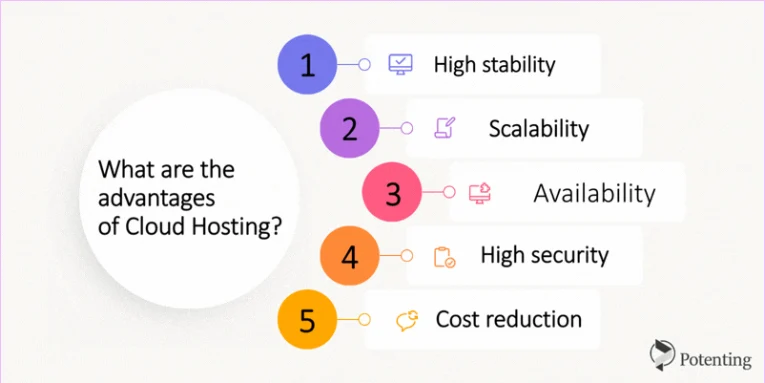
What are the advantages of Cloud Hosting?
This type of hosting offers many advantages for companies, and we will review some of them in this section.
-
High stability
I don’t know whether you have used web hosting before or not. However, if you have used virtual or dedicated servers, you will realize how important stability is. In other web hosting models, if the server has a problem, the website also becomes unavailable. Cloud hosting has solved this problem. This type of hosting is made up of a group of servers, so if one of the servers fails, the user does not even notice it, because the other servers continue working.
-
Scalability
Cloud hosting grows with your business. One of the challenges businesses face with hosting is the amount of resources they need. Your website may currently be small and not receive much traffic, so you do not need many resources. However, this will not always be the case, as your business is constantly growing. Alternatively, on certain days of the month your traffic may increase, while on other days it remains normal. In such situations, you need to adjust your resources accordingly.
Cloud hosting always provides the ability to adjust resources according to your needs.
-
Availability and speed
Cloud data centers are located all around the world. This means that by choosing cloud hosting, you do not necessarily need to select a server in a specific geographical location. Your users will be able to access your website in the shortest possible time from anywhere in the world. This makes it suitable for websites that have a global audience or aim to operate at an international level.
-
High security
As you may have noticed, cloud providers are large and well-organized. For this reason, they invest heavily in security. The security systems in these data centers are constantly updated.
-
Cost reduction
Unlike other hosting models, cloud hosting is highly cost-effective. Its payment model is pay-as-you-go. In addition, users do not need to pay for server maintenance or infrastructure. Organizations only pay for the amount of resources they use.
Types of Cloud Deployment Models
Cloud hosting comes in different types that are suitable for various businesses.
- Public Cloud: In this type of cloud, various resources, including computing power, storage, networking, and more, are provided over the internet. Public clouds are managed and operated by third-party companies that deliver these services to users.
- Private Cloud: This type of cloud is similar to traditional hosting in terms of cost, infrastructure, and limitations. It is deployed within an organization’s environment, and its management and usage are exclusively private, giving the organization full control over its resources and operations.
- Hybrid Cloud: This type of cloud is created by combining a private cloud and a public cloud. It offers the flexibility of both environments and enables organizations to achieve optimal performance for different types of workloads by utilizing the most suitable resources for each task.
- Managed Cloud (Multi-Cloud): A multi-cloud approach is often used when organizations do not want to depend on a single cloud provider. There can be various reasons for this, such as avoiding vendor lock-in, improving reliability, or optimizing costs. By using services from two or more cloud providers, organizations gain greater flexibility and resilience. An environment is considered multi-cloud when it utilizes cloud services from two or more different providers.
Powerful Cloud Infrastructure — Built for Scale
Deploy your cloud instances globally with low latency, high performance, and built-in security.
Cloud HostingTypes of Cloud Hosting
Cloud hosting has several different models. Organizations can use them individually or in combination. To make each model easier to understand, we will compare them to cooking.
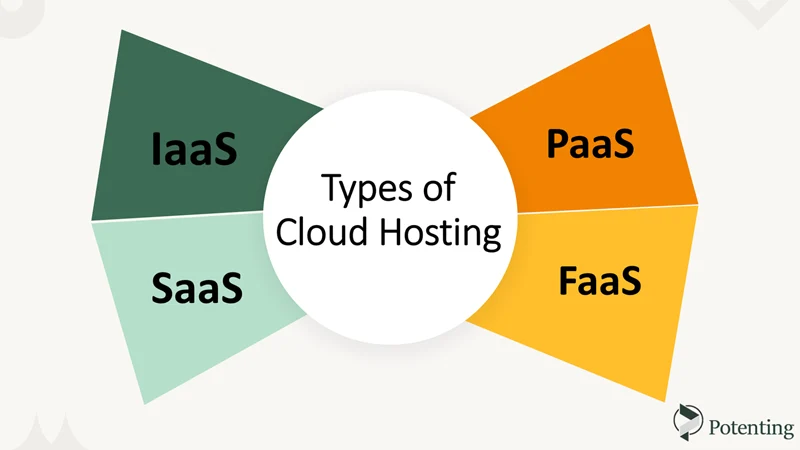
Infrastructure as a Service (IaaS)
In this model, the provider is only responsible for the infrastructure and its management. However, managing everything else—such as the operating system, data, software, middleware, and more—is entirely the organization’s responsibility.
For example, imagine you want to make a pizza. You need ingredients like pizza dough, sauce, cheese, and so on. You buy all of them ready-made, combine them, and put them in the oven. You don’t make the cheese or the dough yourself; you simply use the prepared ingredients.
Platform as a Service (PaaS)
In PaaS deployment, the provider is responsible for everything, from management to performance monitoring and development support. Any kind of disruption in a PaaS cloud is the responsibility of the provider, and they must resolve it.
If we want to compare PaaS to making pizza, it is like not putting any effort into making the pizza yourself; you simply buy it as takeaway. After eating it, you still have to clean up the table because you are not in a restaurant.
Software as a Service (SaaS)
SaaS is a model in which the user consumes cloud services without any involvement in management issues or their complexity. In this model, users have no role in maintenance, management, updates, or similar tasks. The provider is responsible for all of these matters, and the user simply accesses and uses the software via the internet.
As you have probably noticed, SaaS is like going to a restaurant, ordering a pizza, eating it, and leaving the restaurant—without any hassle of cooking or cleaning up.
Function as a Service (FaaS)
Function as a Service (FaaS) is a cloud computing model in which applications are broken down into individual functions that run in response to specific events. In this model, developers do not manage servers or infrastructure; instead, they simply write and deploy code, and the cloud provider automatically handles execution, scaling, and resource management.
If we compare FaaS to making a pizza, it is like preparing only the topping. You do your part, and everything else is handled automatically.
Comparison of Cloud Hosting with other hosting types
In this section, you will understand the main differences between cloud hosting and other hosting types, and you will become familiar with its features.
| Feature | Shared Hosting | VPS | Dedicated Server | ⭐ Cloud Hosting |
|---|---|---|---|---|
| 💰 Cost | Very low | Medium | High | Medium (pay-as-you-go) |
| ⚙️ Resources | Shared among all users | Partially dedicated | Fully dedicated | Distributed across multiple servers |
| 🚀 Performance | Low to medium | Good | Very high | Very high and stable |
| 🔒 Security | Low | Medium | High | Very high (multi-layer + distributed) |
| 📈 Scalability | Very limited | Good | Limited | Excellent (instant scaling up/down) |
| ⏱️ Uptime | Lower | Medium | High | Very high (near zero downtime) |
| 🧠 Management | Easy, basic | Moderate | Complex, requires expertise | Usually easy to flexible (often automated) |
| 👥 Best for | Small websites, blogs | Growing websites | Enterprises, large systems | High-traffic websites, SaaS, modern apps |
Finally
In conclusion, cloud hosting has become a fundamental solution for modern businesses seeking reliable, flexible, and efficient web infrastructure. By leveraging a distributed network of servers, it offers significant advantages such as high availability, scalability, enhanced security, and cost efficiency. As organizations continue to expand their digital presence and demand more from their online services, cloud hosting stands out as a future-ready technology that supports growth and innovation. Understanding its models and service types helps businesses choose the most suitable solution for their specific needs.
FaQ
1. Is cloud hosting secure?
Yes, cloud hosting is generally very secure. Cloud providers use advanced security systems, regular updates, and monitoring to protect data and infrastructure.
2. What are the main types of cloud hosting?
The main types include Infrastructure as a Service (IaaS), Platform as a Service (PaaS), Software as a Service (SaaS), and Function as a Service (FaaS).