Cloud technology is a technology that everyone is talking about today and that has addressed many of the needs of businesses. The cloud does not mean an actual cloud above our heads; rather, it refers to a large network of interconnected servers that work together.
What Is Cloud Computing?
Cloud computing consists of multiple servers that are connected to form a network. This technology is so extensive that different models have been developed to address various needs. The most important models include Infrastructure as a Service (IaaS), Platform as a Service (PaaS), Software as a Service (SaaS), and Serverless Computing. These models can also be used in combination.
Each of these models is built and developed based on specific technologies.
Types of Cloud Computing Services
The main types of cloud computing services include:
- IaaS (Infrastructure as a Service): Cloud-based infrastructure such as servers, networks, and storage is provided to users. The cost is usually calculated based on the amount of resources consumed.
- PaaS (Platform as a Service): A ready-to-use environment for developing, running, and managing applications is provided, eliminating the need for users to directly manage the underlying infrastructure and operating system.
- SaaS (Software as a Service): Software is provided to users online over the internet, eliminating the need for installation, maintenance, or manual updates.
- Serverless Computing: In this model, code execution and server infrastructure management are handled by the cloud service provider. Developers only need to run the required code, and costs are typically calculated based on the amount of code executed and the resources consumed. Serverless does not mean that there are no servers; rather, server management is hidden from the user.
What Is Cloud Hosting?
Cloud hosting is a web hosting model that is considered one of the applications of cloud technology. It is used to host websites and applications and, thanks to the benefits of cloud computing, is highly effective for web hosting.
In this type of hosting, websites and applications are hosted across a network of interconnected servers. Cloud hosting is a subset of cloud computing and is considered one of the cloud-based hosting models.
What Are the Benefits of Cloud Hosting?
Cloud hosting can offer several advantages over some traditional hosting methods due to its use of cloud infrastructure. Its main advantage is that a website or application is not dependent on a single server. Instead, its resources can be provided by multiple servers within a cloud infrastructure.
The main benefits of cloud hosting include:
- Resource Scalability: When traffic increases, the resources available to the website can be scaled up as needed.
- Greater Reliability: Running a service on infrastructure consisting of multiple servers can reduce its dependency on a single server.
- Resource Management: Resources such as CPU, RAM, and storage can be adjusted according to the service’s requirements.
- Suitable for High-Traffic Websites: For websites that need flexible resources and scalable infrastructure, cloud hosting can be a suitable option.
- Reduced Dependency on a Single Server: In cloud architectures, the failure of one server does not necessarily mean that the entire service becomes unavailable. Depending on the architecture, the workload can be transferred to other parts of the infrastructure.
Difference Between Cloud Computing and Cloud Hosting
Cloud computing and cloud hosting are closely related, but they should not be considered the same concept.
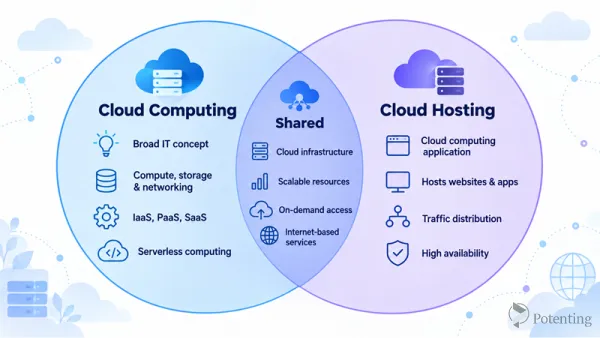
Cloud Computing is a broad concept that refers to using computing, storage, networking, and other IT resources through cloud infrastructure. Services such as IaaS, PaaS, SaaS, and Serverless Computing fall into this category.
In contrast, Cloud Hosting is one of the applications of cloud computing that is specifically used to host websites, applications, and online services.
Simply put, cloud computing is a broader concept, while cloud hosting is one of the services that can be provided using cloud infrastructure.
| Criteria | Cloud Computing | Cloud Hosting |
|---|---|---|
| Definition | The delivery of computing and IT resources over cloud infrastructure | A web hosting model that uses cloud infrastructure to host websites and applications |
| Scope | Broad and includes computing, storage, networking, software, and other IT services | More specific and focused on website and application hosting |
| Main Purpose | Providing flexible access to various IT resources and services | Hosting websites, applications, and online services |
| Infrastructure | A distributed network of interconnected servers and resources | Multiple interconnected servers used to host websites and applications |
| Scalability | Highly scalable based on workload and resource requirements | Resources can be scaled up or down based on website traffic and requirements |
| Resource Types | Compute, storage, networking, databases, software, and more | CPU, RAM, storage, bandwidth, and other hosting resources |
| Management | Depends on the service model, such as IaaS, PaaS, or SaaS | Hosting infrastructure is generally managed by the hosting provider |
| Use Cases | Application development, data processing, storage, AI workloads, and IT services | Website hosting, web applications, e-commerce platforms, and online services |
| Relationship | A broad concept that includes different cloud-based services | A specific application of cloud computing |
| Examples | IaaS, PaaS, SaaS, and Serverless Computing | Cloud-based web hosting services |
Difference Between Cloud Hosting and Traditional Hosting
One of the most important differences between cloud hosting and traditional hosting is how their resources and infrastructure are arranged. In many traditional hosting models, the service is more dependent on a specific server. In cloud hosting, however, the infrastructure consists of multiple servers.
This difference can affect factors such as scalability, reliability, and resource management.
However, it cannot be said that cloud hosting is always better for every website. Small websites with stable traffic may perform well with traditional hosting, while cloud hosting can be a more suitable choice for websites experiencing rapid growth or fluctuating traffic.
Finally
Cloud computing is one of the most important technologies used in modern infrastructure, enabling flexible access to computing, storage, and networking resources. Cloud hosting is one of the applications of this technology and is used to host websites and applications.
The main difference between the two lies in their scope of application. Cloud Computing is a broad concept for delivering IT resources and services through cloud infrastructure, while Cloud Hosting specifically focuses on hosting websites and applications.
Therefore, if you are looking for a hosting solution for a website that may experience increased traffic or require additional resources in the future, cloud hosting can be a suitable option to consider.
FAQ
1. How Are Website Resources Provided in Cloud Hosting?
In Cloud Hosting, resources such as CPU, RAM, and storage can be provided through an infrastructure consisting of multiple servers. The way these resources are allocated depends on the architecture and configuration of the cloud service.
2. How Does Serverless Computing Differ from Cloud Hosting?
In Serverless Computing, the cloud provider manages the servers and the infrastructure required to run the code, allowing developers to focus primarily on executing their code. Cloud Hosting, on the other hand, is generally a specific hosting model used to host websites or applications on cloud infrastructure.