Security is the foundation of today’s businesses. Organizations and companies are constantly seeking solutions to enhance their security and improve their overall performance. One of the most important measures they should take seriously is implementing an SSL certificate—a reliable solution for strengthening security in the online world.
What Is an SSL Certificate?
SSL is a data encryption protocol that secures the connection between a user and a website. When a website has an SSL certificate, a padlock icon appears next to its URL. This icon indicates that the communication between the user and the website is established through a secure connection. As a result, any data exchanged between the user and the server is protected against eavesdropping, tampering, and unauthorized modification.
Data encryption works by breaking information into small packets and transforming it into an unreadable format using encryption algorithms. Consequently, even if hackers manage to intercept the data, they cannot read or make use of it without the correct encryption key and algorithm. We will discuss how the recipient decrypts this information later.
Over the past 25 years since SSL was first introduced, several versions of the protocol have been released. However, many of them were eventually abandoned due to security vulnerabilities. This led to the development of TLS (Transport Layer Security), which offers significantly stronger security and has now replaced SSL. Despite this change, the technology is still commonly referred to as SSL, which is why the term remains widely recognized today.
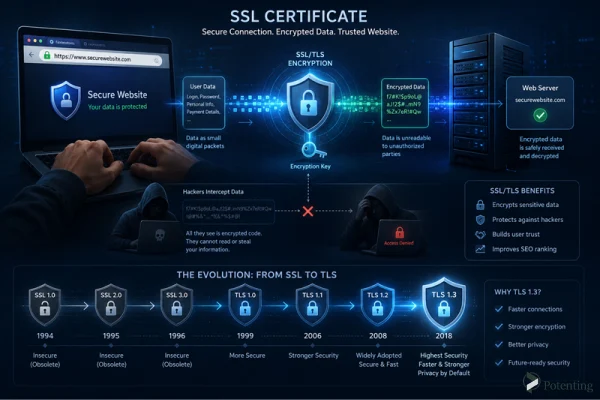
How Does SSL Work?
SSL is designed to ensure that the data exchanged between a user and a server remains secure. It achieves this by using encryption algorithms to transform information into an unreadable format, preventing unauthorized parties from accessing it. But an important question arises: how is this encrypted data read at its destination?
Data is decrypted using two cryptographic keys.
Before discussing these two keys, it is helpful to understand what a key is. A cryptographic key is a string of letters and numbers used to encrypt and decrypt data. In SSL, there are two types of keys: the Public Key and the Private Key.
When a browser connects to a website, it uses the public key. This key is publicly available and is used to establish a secure connection.
The private key, on the other hand, is stored only on the server and is never shared with anyone. It plays the primary role in decrypting the encrypted data. Without it, the information remains unreadable. For this reason, protecting the private key is extremely important. If it is ever compromised, unauthorized individuals could use it to decrypt sensitive data and gain access to confidential information.
Is an SSL Certificate Enough to Guarantee Security?
No. Despite significant advancements in cybersecurity technologies, cyberattacks are constantly evolving as well. It cannot be said that SSL alone can provide complete website security; however, it can significantly protect websites against various types of attacks.
To improve SSL security, it is important to follow these guidelines:
- Always keep your SSL certificate up to date and use newer, more secure versions.
- Obtain your SSL certificate from a trusted and reliable certificate authority.
- Never share your private key with anyone under any circumstances, as exposing it can compromise the security of encrypted data.
What Is HTTPS?
If a website has an SSL certificate, the term HTTPS appears at the beginning of its URL address. In addition, the browser displays a padlock icon next to the website address. These indicators are used to show users that the website is secure and trustworthy.
Is an SSL Certificate Necessary?
Yes. If your website does not have an SSL certificate, browsers will display a warning indicating that the website is not secure when users visit it. This can reduce user trust and cause many visitors to leave the website.
In addition, websites without SSL certificates may rank lower in search engine results, such as Google, compared to secure websites.
You might think that your website does not handle sensitive or confidential information, but having an SSL certificate is still essential. Without SSL protection, hackers may gain access to data transmissions and perform actions such as injecting unwanted advertisements, modifying website content, or redirecting users to malicious pages.
Finally
In today’s digital world, security is no longer an option; it is a necessity. An SSL certificate is one of the most important tools for establishing a secure connection between users and websites. By encrypting data, this technology protects user information and increases trust in a website.
Although SSL alone cannot eliminate all security threats, it is considered one of the fundamental elements of web security. Using a trusted certificate, keeping it updated, and protecting the private key play a crucial role in maintaining website security.
Ultimately, having an SSL certificate is not only essential for protecting user data, but also for improving website credibility, increasing user trust, and creating a safer online experience.
FAQ
1. Does an SSL certificate need to be renewed?
Yes. SSL certificates have a limited validity period and must be renewed or replaced before expiration to maintain website security.
2. Can the SSL private key be shared with others?
No. The private key must remain completely confidential. If unauthorized individuals gain access to it, encrypted data may become vulnerable.
3. What is the difference between SSL and TLS?
TLS is the newer and more secure version of SSL, introduced to address security issues in older SSL versions. Although TLS is used today, many people still refer to this technology as SSL.