In today’s world, where having an online presence is increasingly important for both businesses and individuals, choosing the right infrastructure for hosting a website or application plays a crucial role. One of the most popular and practical options in this area is VPS (Virtual Private Server). By providing dedicated resources within an isolated environment, VPS offers better performance and higher security compared to shared hosting, while still being more affordable than a dedicated server. In this section, frequently asked questions about VPS are answered to help you gain a better understanding of this type of hosting and its benefits.
What is a VPS?
If you are familiar with shared hosting, you know that using it comes with certain challenges that are not very suitable for businesses. VPS was developed to address these challenges. A physical server is divided into multiple sections with dedicated resources using virtualization technology; each of these sections is called a VPS (Virtual Private Server).
Although multiple users operate on the same physical server—similar to shared hosting—the activities of one user do not affect other users, and each virtual server is completely isolated.
Users can install any operating system on a VPS, and there are generally no restrictions on installing different software applications.
How Does a VPS Work?
Users of a Virtual Private Server (VPS) enjoy an experience similar to that of a dedicated server, with the main difference being that the available resources are limited to the allocation assigned to their virtual environment.
A VPS is created using virtualization technology. The hosting provider adds a virtualization layer at the operating system level of the physical server. This layer isolates and partitions the server’s resources, assigning dedicated portions to each virtual server.
Although the underlying hardware infrastructure is shared among multiple users, the VPS environment remains isolated and independent. As a result, users benefit from a secure and private hosting experience similar to that of a dedicated server, with minimal concerns about interference from other users or security-related issues.
Advantages of VPS
One of the most important benefits of a VPS is that it provides a private hosting environment similar to a dedicated server, but at a much lower cost. In addition, VPS hosting offers several other advantages:
- Customization: A VPS is a fully private environment that allows users to install their preferred operating systems and software applications without significant restrictions.
- High Scalability: VPS resources can be increased or decreased easily as requirements change, often without disrupting ongoing operations or affecting performance.
- Advanced Monitoring: With access to control panels and monitoring tools, users can closely track server performance and quickly identify and respond to potential issues or service disruptions.
- Ideal Testing Environment: There are times when developers or businesses need to test code, applications, or new projects but are concerned about affecting their primary systems. A VPS provides a safe and isolated environment for testing, allowing users to experiment and validate changes without risking their personal computers or production environments.
Types of VPS
VPS hosting is generally available in three different types. The right choice depends on your technical expertise, budget, and business requirements.
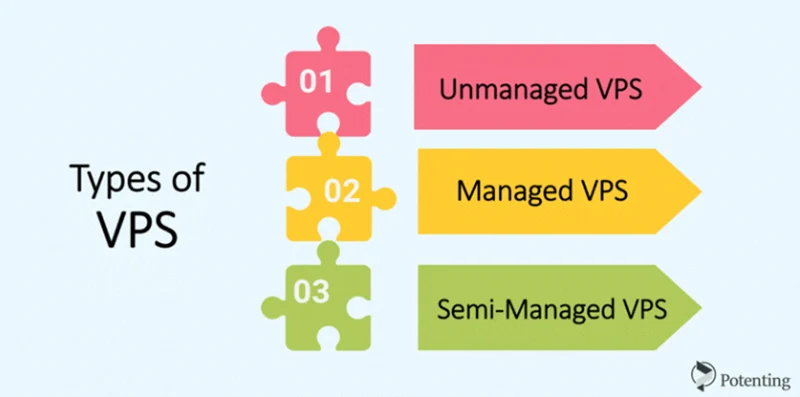
Unmanaged VPS
With an unmanaged VPS, the hosting provider guarantees the availability, stability, and resources of the virtual server. However, the user is fully responsible for managing and maintaining the server.
This includes tasks such as operating system installation and configuration, software updates, security management, resource monitoring, backups, and overall server administration. As a result, an unmanaged VPS is best suited for users with the technical knowledge required to manage a server independently.
Managed VPS
In a managed VPS environment, the hosting provider takes full responsibility for server management. Tasks such as server configuration, software installation, system updates, security maintenance, monitoring, and troubleshooting are handled by the provider.
This allows users to focus entirely on their business operations without having to worry about the technical aspects of server administration.
Semi-Managed VPS
A semi-managed VPS offers a balance between managed and unmanaged hosting.
While the user still has some responsibility for server management, the hosting provider handles essential services such as the installation of core software, basic server configuration, and initial technical support. This option is ideal for users who have some technical experience but prefer assistance with fundamental server maintenance tasks.
Launch Your VPS in Seconds
Full Root Access • NVMe Speed • Global Locations • DDoS Protection Everything you need to scale your projects with confidence.
Difference Between VPS, Shared Hosting, and Dedicated Servers
As mentioned earlier, there are key differences between these three hosting solutions. Here’s a more detailed comparison:
Shared Hosting
In a shared hosting environment, server resources are shared among multiple users. This means you cannot customize or choose the specific hardware resources allocated to your website based on your business requirements. Since all users share the same server environment, the performance of one website can potentially affect others.
Dedicated Server
A dedicated server is the complete opposite of shared hosting. With a dedicated server, all hardware resources—including CPU, RAM, storage, and bandwidth—are exclusively assigned to a single user. This provides maximum performance, control, and flexibility, but it also comes with significantly higher costs.
VPS (Virtual Private Server)
A VPS sits between shared hosting and dedicated servers. It offers dedicated resources within a virtualized environment, providing greater control, performance, and isolation than shared hosting, while remaining much more affordable than a dedicated server. As a result, VPS hosting is often considered an ideal balance between cost and performance for growing businesses and websites.
| Feature | Shared Hosting | VPS | Dedicated Server |
|---|---|---|---|
| Resources | Shared | Semi-dedicated | Fully dedicated |
| Performance | Lower | Medium to high | Very high |
| Control | Low | Medium | Full |
| Security | Lower | Better | Very high |
| Cost | Low | Medium | High |
| Best for | Small websites | Growing websites | Large projects |
Finally
VPS can be considered a smart middle-ground solution between shared hosting and a dedicated server, offering a combination of high performance, strong security, and reasonable cost. This type of hosting allows businesses and developers to manage their projects with greater control, dedicated resources, and improved flexibility, ensuring a more reliable and scalable environment. Therefore, if you are looking to enhance the performance of your website or application without the high cost of a dedicated server, a VPS can be one of the best choices for your future growth and scalability.
FAQ
1. Who is VPS suitable for?
It is suitable for growing businesses, developers, high-traffic websites, and projects that require dedicated resources.
2. Can VPS resources be upgraded?
Yes, usually RAM, CPU, and storage space can be easily increased.
3. How much does a VPS cost?
The cost of a VPS is between shared hosting and a dedicated server, and it varies depending on the resources and the type of management.