Web hosting is a broad field. It is not limited to just a single server and encompasses a wide range of businesses. With the widespread global growth of the internet, most businesses are looking to establish an online presence, which has made web hosting more widely utilized than ever.
What is a Virtual Server (VPS)?
A virtual server is essentially a physical server whose resources are shared among multiple users using virtualization software. However, these resources are strictly dedicated, meaning the behavior of other users has very little impact on your server’s performance.
For a better understanding, let’s look at it like an apartment building. The physical server is like a residential complex containing several units, where each unit belongs to a specific person. All these apartments have their own entirely separate kitchens, restrooms, and bathrooms; only the land they are built on is shared.
In this analogy, the land represents the shared physical server, the apartments are the VPS, and facilities like the kitchen and bathroom represent the server resources that belong exclusively to each individual.
What is a Dedicated Server?
A dedicated server is another type of web hosting where an entire physical server and all of its resources are allocated exclusively to a single user. If we were to compare this server to a house, we could say that a dedicated server is like a standalone, private villa. This villa is very spacious, and all of its rooms, the kitchen, the restroom, and the bathroom are completely at the disposal of one person. While multiple people could potentially live in this villa together, it is currently in the exclusive possession of just one individual.
VPS vs. Dedicated Server, What’s the Difference?
One of the most important and difficult choices for medium to large businesses is deciding between a virtual server (VPS) and a dedicated server. This is truly a challenge, and given the critical impact of hosting type on website performance, there is no room for risk or making the wrong choice. To make a better decision, you need to familiarize yourself with the features and differences of these two servers.
Speed and Stability
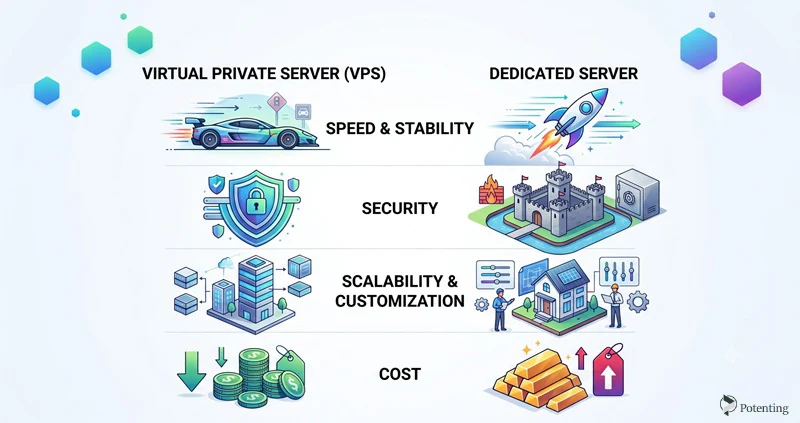
A virtual server offers high speed and stability, and most businesses that are tired of shared server issues switch to using a VPS. Since the resources and server environment are completely isolated, problems like excessive resource usage and slowdowns occur less frequently. Of course, this also depends on the amount of resources you have purchased.
A dedicated server, on the other hand, boasts exceptionally high stability and speed, performing better than a VPS. This is completely natural because the resources are entirely dedicated, and the impact of other users’ activities on the server is absolutely zero.
Security
In terms of security, a VPS performs well, and its isolated nature reduces security risks. However, security is much higher on a dedicated server. After all, a virtual server shares a physical environment, and if one user’s virtual server is breached, there is a risk that your server’s security could also be compromised.
Scalability and Customization
Although a virtual server is far better than a shared server regarding scalability and customization, it cannot match the capabilities of a dedicated server. Ultimately, it is much easier to make modifications in a standalone villa than in an apartment building.
Cost
Unlike the other factors where the dedicated server had the upper hand, it must be said that a VPS has a lower cost compared to a dedicated server, making it a suitable and cost-effective choice for many businesses.
Find the Right Hosting for Your Business
Whether you choose a VPS for flexibility and affordability or a dedicated server for maximum performance, we have the perfect hosting solution for your needs. Compare our plans and get started today.
VPS vs. Dedicated Server
| Feature / Criteria | Dedicated Server | Virtual Private Server (VPS) |
| Environment & Structure | The entire physical server is entirely and exclusively dedicated to you and is not shared with anyone else. | A single physical server is divided into isolated virtual compartments via software (Hypervisor) and shared among multiple users. |
| Hardware Resources | Exclusive access to all resources (CPU, RAM, Storage, and Network) with no resource wastage. | Utilizes a specific portion of a physical server’s resources allocated dedicatedly for that virtual environment. |
| Target Audience | Professional, large-scale businesses and organizations with high resource demands. | Medium-sized businesses with lower requirements looking for an economical solution. |
| Cost | High (due to full ownership of a physical hardware unit). | Cost-effective and more affordable (since hardware costs are shared among multiple users). |
| Scalability (Upgrades) | Harder and more expensive; requires adding physical components (e.g., a new drive), which may cause downtime. | Very easy and flexible; upgrading resources and changing subscription plans is done simply and quickly. |
| Performance | Exceptionally high and optimal, as there are no hardware limitations caused by sharing with others. | Good and adequate, but inherently ranks lower than a dedicated server due to the shared underlying hardware. |
| Flexibility & Management | Full end-to-end control over settings, operating system, and security; however, it requires high technical expertise to avoid system damage. | Easier management via virtualization platforms; customization is possible but more limited compared to a dedicated server. |
| Security & Privacy | Highest level of security; since your website is hosted exclusively, data and privacy are protected in the best possible way. | Environments are isolated by a software layer to prevent interference, but they still reside on a shared physical infrastructure. |
Which Server is Suitable for Our Business?
Imagine living in a large family; would you fit into a medium-sized apartment? No, you wouldn’t, or even if you did, you would be dissatisfied with the lack of space. However, if it were a standalone villa, you could live there comfortably.
Now, suppose you don’t have many members and are a small family; in this situation, an apartment would be perfectly suitable for your living needs. You can live in this apartment until your family grows and you are ready to move into a villa.
If you have a high-traffic website and require substantial resources, a dedicated server is the right fit for your business. But if your traffic is average, a virtual server (VPS) will be entirely sufficient for you.
Finally, even if you have low traffic but deal with highly sensitive data and information that require maximum security, a dedicated server remains the best option.
Finally
Ultimately, choosing between a virtual and a dedicated server depends on your business needs, budget, and goals. Neither option is absolutely superior to the other; rather, the best choice is the server that optimally aligns with your website’s current situation and future plans.
We recommend carefully evaluating your traffic volume, business growth rate, and required security level before making a final decision. With a smart choice, you can build a powerful and stable infrastructure for your online presence and focus on expanding your business with complete peace of mind.
FAQ
1. In terms of cost, is a virtual server better or a dedicated server?
A virtual server (VPS) costs significantly less than a dedicated server. It is a highly cost-effective and economical choice for startups and medium-sized businesses that do not require the resources of an entire physical server.
2. My website has low traffic; do I need a dedicated server?
Generally, for low to average traffic, a virtual server is completely sufficient. However, if your user data and information are highly sensitive and you require the highest possible level of security and isolation, utilizing a dedicated server remains the best option.