You search for something on the internet and enter different websites with just one click. Or perhaps you type in a domain name, and the website appears right before your eyes. But things are not actually that simple. Everything has been simplified so that you can use it easily, while many organizations and infrastructures work behind the scenes to make this simplicity possible. One of the most important parts of this process is domain registration.
Registering a domain may not be difficult, but choosing the right domain name can be challenging and requires a great deal of patience and attention.
What Is Domain Registration?
A domain works like an address on the internet. In the physical world, when you want to go to a restaurant, you first find its address and then head in that direction. A domain plays the same role in the online world.
A domain name consists of several parts, such as the name, extension, and subdomain. Building and launching a website involves several steps, and registering a domain is the first one. Keep in mind that a domain is different from web hosting and DNS.
To get a domain, you need to visit a domain registrar and enter your desired domain name. If the name is available and has not already been registered by someone else, you can rent and register it.
Domain Registration Organizations
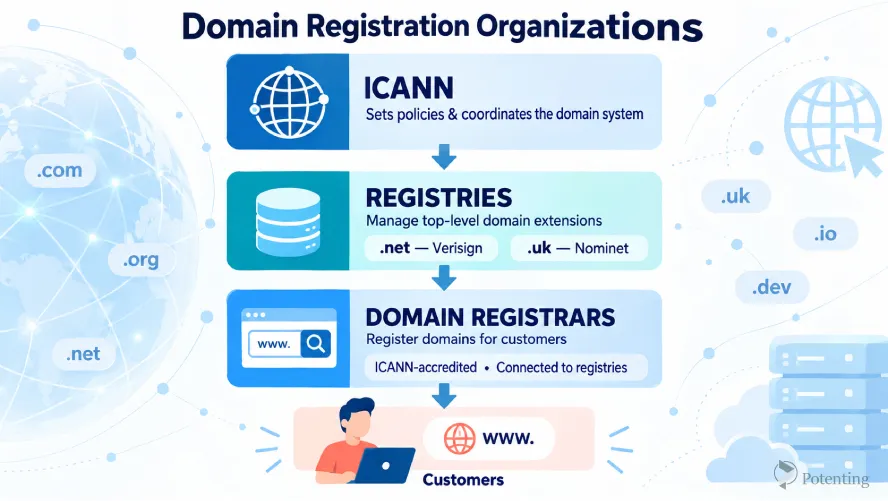
Different organizations work together to keep the domain registration system running and ensure that internet addresses function properly.
ICANN
ICANN is perhaps the most important organization in the domain registration industry. It establishes the rules and requirements for domain registration, but it does not register domains directly. Instead, it provides the framework that allows other organizations to offer domain registration services.
ICANN develops policies related to the creation, transfer, management, and registration of domains. It also determines which organization is responsible for managing each domain extension.
Registries
Top-level domain extensions are managed by organizations known as registries. For example, if your domain uses the `.net` extension, its registration is managed by Verisign, while the `.uk` extension is managed by Nominet.
A name you have chosen for your domain may be unavailable with one extension but available with another. This is because the name may have already been registered under one extension while remaining available under others.
However, you do not register your domain directly through a registry, nor do you usually communicate with one. Registries establish rules for matters such as registration periods, renewals, and domain management.
Domain Registrars
A domain registrar is a company you use to register a domain. Domain registration companies such as Potenting are accredited by ICANN and connected to registries.
Many domain registrars are available, and each one offers its own features and services. These companies mainly compete in terms of pricing and the quality of their customer support.
In the domain registration industry, the terms Registry, Registrar, and Registrant are sometimes confused with one another:
- Registry: The organization that manages a domain extension.
- Registrar: The company that provides domain registration services.
- Registrant: The person or organization that holds the domain.
Why Are There Different Rules for Domain Registration?
It all starts with choosing a domain extension and its registry. The rules you need to follow when using a domain are determined by this choice. Once you select an extension and its registry is identified, matters such as domain registration and transfer rules, contact information requirements, and domain management procedures are determined by that registry. This is why different registries may have different rules.
Generic Top-Level Domains (gTLDs)
All generic top-level domains, or gTLDs, are overseen by ICANN. These domains are generally available to everyone, regardless of their geographical location, and they broadly follow ICANN’s policies.
This raises an important question: if ICANN sets the rules, what role does the registry play? ICANN establishes the general standards for these extensions. For example, it may specify that they must be available for registration by anyone. However, the more detailed rules and day-to-day management of these extensions are handled by their registries. For instance, the registry determines how long a domain’s redemption period lasts or how much time must pass after expiration before the domain becomes available again.
Country Code Top-Level Domains (ccTLDs)
Each country has a two-letter domain extension that can be registered according to the rules and regulations of that country’s registry. These extensions are not directly managed by ICANN, meaning they may not follow all of its standards.
Some national registries allow domains to be registered through foreign companies, while others do not. Some country-code extensions are reserved for government organizations, while others are also available to private companies. In general, ccTLDs do not follow a single set of registration requirements, and each one has its own rules.
Steps for Registering a Domain
First, you need to choose your domain name based on the established domain naming standards. Once you have selected a name, it is time to choose an extension. At this stage, you should consider which extension is the most suitable for your business. For example, if your business is related to the food industry, you can use the `.food` extension. If your target audience is located in a particular country, you can choose that country’s domain extension.
The next step is to choose a suitable domain provider that offers reasonable pricing, reliable support, and good services. At this stage, Potenting can be a suitable option for you. Visit the Potenting website, go to the “Web Hosting” section, and then select “Domains.”
In this section, enter your desired domain name. The system will show you which extensions are available for that name. If your preferred name is unavailable with the selected extension, you can change either the domain name or its extension. The AI tool available on the Potenting website can also help you with this process.
Once you have registered the domain, our specialists begin their work and contact the registry.
What Happens Behind the Scenes During Domain Registration?
The service provider contacts the domain registrar and informs it that a domain with this name and extension has been registered. The registrar then adds the domain name to its database and marks it as no longer available for registration.
The next step is to assign nameservers to the domain so that it can be connected to a server. This process is also handled by the registry, which provides the relevant information to the service provider. Finally, this information is passed on to you.
Who Owns a Domain?
You should know that when you register a domain, you are essentially renting it for a specific period. If you do not renew it according to the registry’s rules after this period ends, you will lose access to it. Therefore, you do not permanently own the domain.
The domain and the right to use it are granted to you for a specific period, while the registry is technically its owner. Any change to the domain’s status, such as transferring its ownership, must be approved by the registry.
Different registries have different rules. Some are more flexible, while others are stricter. Before making your final decision, make sure to check which registry is the most suitable for you.
Finally: How do platforms like WHMCS connect to domain registration companies?
Ultimately, systems such as WHMCS connect to domain registration companies through APIs and dedicated registrar modules. These modules receive users’ information and requests from WHMCS and send them to the domain registrar. Through this connection, operations such as checking domain availability, registering, renewing, transferring, and deleting domains, changing nameservers, obtaining authorization codes, and checking domain status can be performed automatically. The registrar then sends the result of each request back to WHMCS so that the domain information in the user’s control panel can be updated. If the API becomes unavailable, the account balance is insufficient, or the information between the two systems is not synchronized, some operations may be delayed or require manual review.
FAQ
1. What role does the EPP protocol play in domain registration and management?
EPP is a standard protocol used for communication between registrars and registries. Registrars use it to register, renew, transfer, and delete domains, update registrant information, and configure nameservers.
2. How are EPP request limits managed?
Registries usually limit the number of connections and requests that each registrar can submit. Registrars manage these limits by queuing requests, controlling their submission rate, and retrying failed requests after a short delay.
3. What does Session Pooling mean in registry connections?
Session Pooling means keeping several active and ready-to-use connections between the registrar and the registry. This removes the need to create a new connection for every request and makes domain operations faster.
4. How are temporary EPP errors identified and resolved?
These errors are identified by examining EPP response codes, error messages, and server logs. Depending on the error, the request may be retried, its information may be corrected, a new connection may be created, or the issue may be escalated to the technical team.