If you are starting an online business or have friends who are active in this field, you have probably heard and seen a lot of discussion about security and concerns surrounding it. Website security is one of the most important and fundamental infrastructures that ensures the stability and continuity of a business, and it consists of a set of measures and practices.
Why Is Website Security Important?
As technology has advanced, security threats have also become more sophisticated. These threats are increasing every day, and their methods are constantly being updated, to the point where yesterday’s defensive measures may be vulnerable to today’s attacks. That is why you always need to stay up to date.
These threats come in many different forms and can have different impacts on a website. For example, they can take a website offline, alter its appearance, or even gain control of it and use it for illegal activities. The theft of users’ information and infecting their systems with malware through your website are other problems that may occur.
Alongside all the security measures you can take to secure your website, which we will discuss further below, you should also pay attention to the hosting service you choose. It is better to choose a suitable hosting service with a high level of security in order to prevent many potential risks. If you’re looking for hosting purchase that is secure, reliable, and affordable, potenting is here for you.
Understanding Different Security Threats
- Malware: Malicious software or infected code that hackers and cybercriminals use to gain access to your website and its information.
- Defacement: This occurs when a cybercriminal gains access to your website and its code and changes the appearance or content of the site without your knowledge. In such situations, your users’ information may also be at risk.
- DoS and DDoS Attacks: In these attacks, a large number of bots send requests to the website’s server, preventing legitimate users from accessing the website.
- And more…
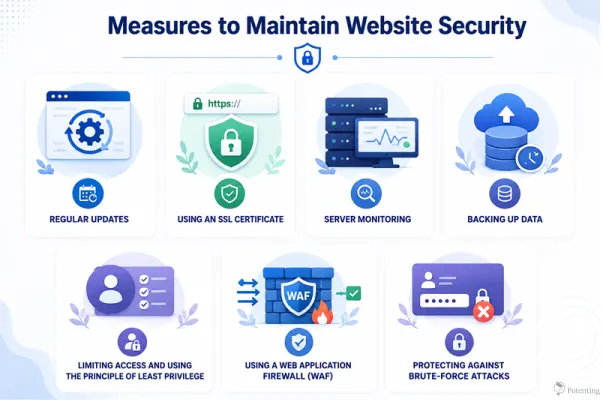
Measures to Maintain Website Security
Here, we will look at the most important steps you should take to maintain your website’s security.
Regular Updates
Updates may not seem very important to many of you, but you should know that if you keep postponing your updates, you are essentially making your website an easy target for hackers and cyberattacks. When a program receives an update, it usually means that vulnerabilities have been identified and fixed. By keeping your software up to date, you eliminate these vulnerabilities. If you fail to do so, however, you are making a serious mistake.
Using an SSL Certificate
Fortunately, even if you do not take SSL certificates seriously, Google considers websites without them to be security risks, which means you are, to some extent, required to obtain one. An SSL certificate encrypts the data exchanged between the user and the server. If someone attempts to access the data while it is being transmitted, encryption prevents them from doing so. Browsers are also sensitive to the use of SSL certificates and inform users whether a website is secure when they visit it.
Server Monitoring
Continuous server monitoring helps ensure that your server and website are functioning properly. If a problem or disruption occurs, you can detect it quickly and take defensive measures. Monitoring can also alert you to potential security issues, allowing you to take action before they become more serious.
Backing Up Data
These measures cannot guarantee with 100% certainty that your website will never experience a problem. That is why regular backups are essential. If your website’s data is lost due to a security issue or becomes compromised by malware, you will still have a secure copy of your data and can restore it.
Limiting Access and Using the Principle of Least Privilege
One of the most important ways to improve website security is to carefully control who has access to your website, server, and its resources. Not every user or employee needs access to all parts of a website. The Principle of Least Privilege (PoLP) means that each user should only have the minimum level of access required to perform their tasks. By limiting permissions, you can reduce the potential damage if an account is compromised. For example, a regular website administrator should not necessarily have access to sensitive server configurations or database management tools. Regularly reviewing user accounts and removing unnecessary permissions can also help keep your website more secure.
Using a Web Application Firewall (WAF)
A Web Application Firewall (WAF) is a security layer that monitors and filters traffic between users and your website. It can identify and block many types of malicious requests before they reach your web application or server. A WAF can help protect websites against common threats such as SQL injection, Cross-Site Scripting (XSS), malicious bots, and some forms of application-layer attacks. Using a WAF does not eliminate the need for other security measures, but it can provide an additional layer of protection and reduce the impact of many common attacks.
Protecting Against Brute-Force Attacks
Brute-force attacks occur when attackers repeatedly try different usernames and passwords to gain access to an account. These attacks can be particularly dangerous for login pages, administrator accounts, and other systems that use password-based authentication. To reduce the risk, you should use strong and unique passwords, enable multi-factor authentication (MFA) whenever possible, and limit repeated failed login attempts. Additional measures such as account lockouts, login rate limiting, CAPTCHA, and monitoring suspicious login activity can also make brute-force attacks much more difficult for attackers.
Finally: How Does Website Security Affect Businesses?
Website security is extremely important for businesses because it protects sensitive user and business information against cyber threats such as DDoS attacks, SQL injection, and malware. Following security best practices also helps prevent website disruptions, financial losses, damage to brand reputation, and legal penalties. By maintaining the security and availability of a website, strong security practices can also contribute to better SEO performance and increased user trust.
FAQ
1. What are the most common website security threats?
Common threats include malware, website defacement, DoS and DDoS attacks, SQL injection, data theft, and unauthorized access.
2. Why are regular website updates important for security?
Updates often fix known security vulnerabilities. Delaying updates can leave your website exposed to hackers and cyberattacks.