Web hosting is considered one of the most important pillars of any online business and plays a significant role in its growth, development, and success. Choosing a suitable hosting service requires familiarity with the different types of hosting and servers, as well as an understanding of the features and capabilities of each. A dedicated server is regarded as one of the most powerful types of web hosting services, and in this article, we will examine its features, advantages, and applications.
What is a dedicated server?
A dedicated server is a type of web hosting service in which all the resources and capabilities of a physical server are fully allocated to a single user or organization. Unlike a virtual server, in this type of hosting, no other users have access to the server’s resources, and all processing power, memory, and storage capacity are assigned to one client.
Dedicated servers do not use virtualization technology; therefore, the user has complete control and management over the server, its operating system, and its configurations. In addition, because resources are not shared with other users, the server’s performance, speed, and stability are significantly higher than those of virtual servers. For this reason, a dedicated server is an ideal option for websites, applications, and businesses that require powerful resources, high security, and stable performance.
Features of a Dedicated Server
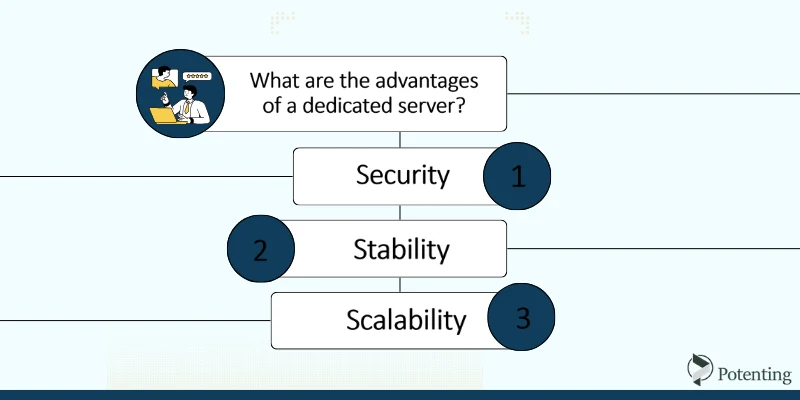
Since control of the server and all its resources is in the hands of the user, this type of hosting offers many features and advantages.
High Security
In a dedicated server, full management of the server is handled by the user, who can update and customize security settings according to their own needs and policies. Also, due to the dedicated nature of this type of server, the number of unauthorized access attempts and simultaneous logins is reduced, providing an isolated and secure environment for the user.
In addition, users can create custom firewalls, independently manage security patches and updates, and configure access control policies according to their preferences. This level of control and flexibility makes dedicated servers a suitable option for businesses that place a high priority on security, stability, and advanced resource management.
Stability
When all server resources are dedicated to a single user, issues such as slowness, downtime, and instability are significantly reduced. In such conditions, server resources are not shared, which leads to improved speed, stability, and overall system performance.
Scalability
In a dedicated server, users have complete freedom to make changes and customize the system. They can apply their desired settings without restrictions and configure different parts of the server according to their needs.
This customization may include selecting and changing the operating system, as well as adjusting resources such as the CPU, RAM, storage space, and even the graphics card.
Challenges of Dedicated Servers
A dedicated server has many advantages, but it also comes with challenges that make it unsuitable for everyone.
High Cost
The cost of a dedicated server is higher compared to shared and virtual servers. Imagine that the resources of a server are divided using virtualization and assigned to 10 users. Now, instead of being shared among 10 users, the entire server is allocated to just one user in a fully dedicated manner. Naturally, this leads to a higher cost.
Need for Technical Knowledge
Not everyone can use a dedicated server, as it requires specialized knowledge. Server management and configuration, including operating system installation, software setup, security measures, and more, require expertise in server administration. However, these issues can be addressed by using a managed dedicated server.
What are managed and unmanaged dedicated servers?
As mentioned earlier, using a dedicated server requires technical knowledge. Server management and configuration can be complex, and not everyone is able to handle it. For this reason, providers offer dedicated servers in two forms: managed and unmanaged.
In an unmanaged dedicated server, all administrative tasks, configuration, security measures, and everything else are entirely the responsibility of the user. The provider only offers support in case of hardware failures or technical issues; otherwise, all responsibility lies with the customer.
A managed dedicated server, on the other hand, is designed for users who do not have specialized technical knowledge. In this type of service, the provider takes care of all security tasks, management, configuration, and other responsibilities. As a result, the user does not have to worry about server administration and can focus on growing and developing their business.
Is a dedicated server suitable for all websites?
Given the challenges of dedicated servers discussed earlier, it is important to understand that this type of server is not suitable for all businesses. Since all server resources are allocated to a single user, small businesses usually do not need this level of capacity. On the other hand, the high cost of this service makes it economically inefficient for many businesses.
If we ignore the cost factor, the need for technical expertise to manage the server is another major challenge. Not all managers have the technical knowledge required for server administration, and purchasing a dedicated server for them may not only fail to provide growth opportunities but could also lead to business decline due to incorrect configuration.
Dedicated servers are suitable for websites with extremely high traffic and a need for high bandwidth, such as large e-commerce sites. They are also ideal where security is a top priority and requires strict management, such as banking applications. In addition, they are appropriate for systems that need to run large databases and prioritize stability, such as news media platforms.
Applications of Dedicated Servers
- Big databases: Dedicated servers are used to store, manage, and process large volumes of data, providing high performance and fast access to information.
- Organizational networks: Companies and organizations use dedicated servers to manage users, share files, control access, and run internal services securely.
- Artificial intelligence (AI): Dedicated servers provide the computing power needed to run AI models, process complex data, and deliver AI-based services efficiently.
- Machine learning: Training and deploying machine learning models require significant computational resources, which dedicated servers can provide reliably.
- Online games: Dedicated servers host multiplayer online games, ensuring stable performance, lower latency, and a better gaming experience for players.
- Banking applications: Banks use dedicated servers to process financial transactions, store customer information securely, and maintain high levels of reliability and security.
- Data analysis: Dedicated servers enable the processing and analysis of large datasets, helping organizations extract valuable insights and make informed decisions.
Choosing a Dedicated Server Provider
To make a good choice, there are several essential steps you should follow.
- First, check the data center to ensure it is of high quality in terms of security features, cooling systems, network quality, and more.
- The availability of 24/7 support and guarantees such as high uptime and stability from the provider is also very important.
- Choose between managed and unmanaged dedicated server plans.
- Check whether the provider offers root access.
Finally
In conclusion, a dedicated server is one of the most powerful and reliable web hosting solutions. By providing full resources, high security, and remarkable stability, it is considered an ideal option for large businesses and sensitive projects. However, its high cost and the need for technical expertise make it unsuitable for all users. Therefore, the decision to use a dedicated server should be based on actual needs, traffic volume, required level of security, and technical management capability in order to achieve the best performance and efficiency.
FAQ
1. What is the difference between a dedicated server and a virtual server?
A dedicated server is a full physical computer that belongs to only one user, while a virtual server is a part of a physical computer that is divided separately among multiple users.
2. Is it possible to upgrade a dedicated server?
Yes, it is usually possible to increase resources such as RAM, CPU, and storage space according to your needs.