In today’s world, having an online presence is essential for anyone who wants to be seen and connect with their audience. One of the first and most important steps in entering this space is choosing and registering a suitable domain name for a website. A domain is, in fact, the address that users use to access your website, and it plays a major role in building digital identity and establishing trust.
In this text, we will become familiar with the concept of domain names, how they work, the structure of internet domains, the types of domain extensions, and the steps involved in registering a domain. This will help us gain a better understanding of this essential part of the internet and its importance in creating a website.
What is a domain name?
A domain name is the system that allows people to find your website on the internet. Instead of an IP address, the domain name is displayed in the browser’s URL bar. Although a domain name may seem like just an ordinary name, it actually plays a significant role in the growth of your business and in building users’ trust. The first thing users see is your domain name. No two domain names are identical on the internet, which means it helps create a unique identity for you.
How do domain names work?
The internet is a global network where all devices communicate with each other through IP addresses. IP addresses are made up of numbers, and remembering all of these numbers is difficult. To solve this problem, the Domain Name System (DNS) was created. With this system, there is no need to memorize IP addresses, as domain names are used instead. DNS converts the domain name into an IP address.
Introduction to URL and Domain Name Structure
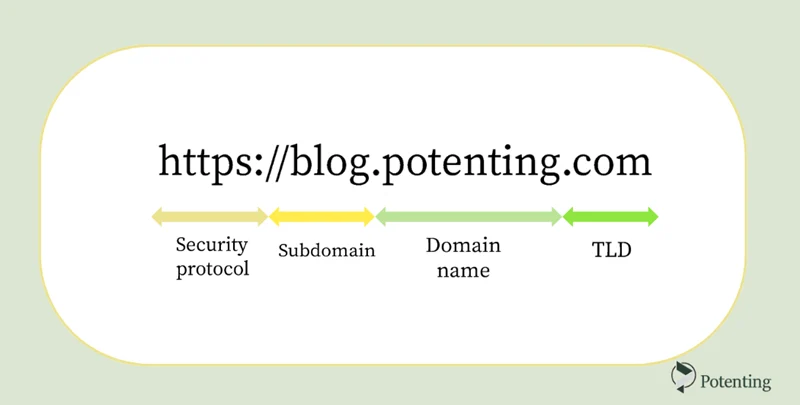
A URL consists of several components, and the domain name is one of them. In this section, we will take a closer look at each of these components.
- Security protocol: All websites need to use a security protocol, which is HTTP or HTTPS. The first part of the address contains the protocol name.
- Subdomain: A subdomain may appear before the main domain name. This part is separated from the main domain by a dot and is used to help organize the website’s structure.
- Domain name: This is the most important part of any domain. It is unique and represents the identity of a business.
- Top-level domain (TLD): The last part of any domain name is the domain extension, which is separated from the domain name by a dot and comes in different types.
Types of domain extensions
TLD is the domain extension, which every domain must have. In this section, we will learn about its different types.
gTLD stands for Generic Top-Level Domain and refers to general-purpose domains. In other words, registering these extensions is open to the public, and people can choose one that suits their business. Some of the most commonly used gTLDs include .com, .net, .name, and others.
- ccTLD refers to country code domains and is the abbreviation of Country Code Top-Level Domain. Each country or geographic region has its own specific domain extension. These extensions are usually two letters long, and their registration rules vary. Examples of these extensions include .uk for the United Kingdom and .de for Germany.
- sTLD is another type of domain extension and stands for Sponsored Top-Level Domain. It is specifically designed for organizations. Registering and using an sTLD requires permission from a sponsoring organization. For example, .edu is used for educational institutions and .gov is used for government websites.
Register Your Perfect Domain Today
Secure your online identity with the perfect domain name. Choose from .COM, .NET, .ORG, .IR and hundreds of other domain extensions at unbeatable prices.
🔍 Buy DomainsHow can a domain be registered?
To have a website, you need to register a domain. Domain registration can also be done in a few simple steps.
Domain name
One of the most important steps in registering a domain is choosing the domain name. As mentioned, this name represents the identity of your business, so it should be chosen carefully. Before selecting a name, it is better to consider the following points.
- It is better to use keywords related to your business in the domain name. The name should be chosen in a way that reflects the nature of your business.
- The brand name and domain should be memorable so that users can remember it and return to your website again. For this reason, it is better to choose a short and effective domain name.
- Using different characters and numbers that split the name into multiple parts is not recommended.
- If your business covers a specific geographic area, it is better to include it in the domain name.
Domain extension (TLD)
After choosing your domain name, it is time to select a domain extension. There are many domain extensions available, and you should choose one based on the type of your business. It is better to select an extension that is relevant to your business. You should take this choice seriously, as it has a significant impact on your website’s credibility.
Availability check
After choosing the domain name and extension, you need to check whether the domain name is available or has already been registered by someone else. To do this, you should use domain providers such as Potenting. In the domain registration section of these providers, you enter your desired domain name, and if it is not available, you must either change the domain name or choose a different extension. Potenting consultants can also help you make the best choice.
Domain registrar
At this stage, it is time to choose a domain service provider to register your selected domain. When choosing a provider, you should consider factors such as price, support, and more.
Finally
In conclusion, choosing and registering a suitable domain is not just a technical step in launching a website; it is one of the most important decisions in building an online identity for a business. A good domain can build user trust, make your brand more memorable, and make access to your services or products easier. Therefore, by carefully selecting the name, extension, and domain provider, you can create a strong foundation for your online success.
In this article, we have covered everything you needed to know about domains. We hope it has been useful for you.
FAQ
1. What is DNS?
DNS is a system that converts a domain name into an IP address so that the browser can locate the website.
2. How can you register a domain?
To register a domain, you need to choose a suitable name, select a domain extension, check its availability, and then purchase it through a domain registration company.