Setting up an online store nowadays is very easy, and many businesses have entered this space. But have all of them succeeded in this field?
The answer is no.
Many factors influence the success of an online business, and one of the most important is hosting. The hosting service and its server location affect speed, security, stability, and more. The question is: what type of hosting is suitable for e-commerce websites?
The importance of hosting for an online store website
An e-commerce website is different from other websites and has different requirements. Online stores include product pages, online payment pages, user accounts, and more, and all of this information must be updated continuously. On the other hand, these websites experience high traffic, and the hosting needs to be able to handle multiple processes simultaneously in real time. Considering these factors, e-commerce hosting must be able to fully manage all of these requirements.
Choosing good hosting is important, because without it problems such as slow website performance, payment errors, security risks, and others may occur. Each of these issues can seriously damage a brand’s reputation.
What factors should be considered when choosing hosting?
There are several essential points to consider when choosing hosting, and they must be carefully taken into account.
- The provider should guarantee an uptime of over 99.9%. This is very important because it ensures the stability of the website.
- There should be automatic daily backups to prevent data loss.
- Integration with a CDN and higher speed for loading content for global customers is important.
- Scalability and the ability to adjust resources in response to changes in traffic should be provided.
- Professional and comprehensive support is also necessary so that in case of disruptions, issues can be resolved as quickly as possible.
Features of suitable hosting for an e-commerce website
Hosting has a significant impact on the development of an e-commerce website, and understanding its key features is important for making a better choice.
High security
In e-commerce websites, there is a section called the user account area where people enter personal information such as their phone number, email address, address, and more. Your website must have a high level of security so that users feel confident creating an account and becoming customers of your website.
Protection against DDoS attacks
DDoS attacks are a type of cyberattack aimed at taking a website offline by suddenly overwhelming it with a large number of requests. The hosting you choose should be resistant to these attacks and include built-in protection so that websites hosted on it do not experience disruptions.
WAF firewall (Web Application Firewall)
The presence of this type of firewall ensures that malicious traffic is filtered before it reaches the website and causes any disruption. It also has the ability to defend against various cyberattacks, including SQL Injection and XSS.
Malware scanning
The provider should check the servers daily and use scanning to ensure that there are no infected files, malicious code, or backdoors.
Server response time (TTFB)
In online stores, even a small delay can significantly increase the bounce rate. In such conditions, server response time should be reduced to under 200 milliseconds. The hosting should have low latency for responses.
Type of hard drive
Hosting services that use SSD drives are up to 20 times faster than those that use traditional hard drives. It is better for e-commerce hosting to use SSD storage in order to improve performance and speed.
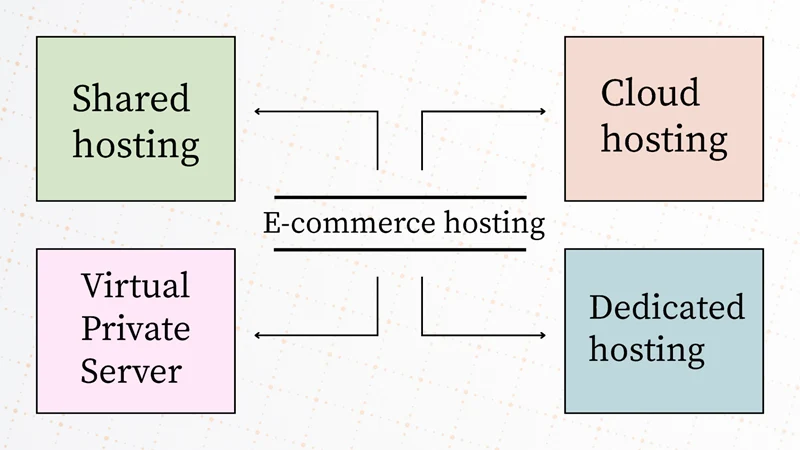
Review of different types of hosting for e-commerce websites
To make a correct and principled choice in the field of web hosting, you need to be familiar with the different types of hosting, understand their advantages and disadvantages, and then select the best option based on your business needs.
Shared hosting
It can be said that shared hosting is not the most suitable option for many websites, especially e-commerce sites. In this type of hosting, the resources of a single server are shared among multiple websites. As a result, if one website uses a large amount of resources, the performance of other websites will also be affected, leading to slower speeds. However, shared hosting can be an appropriate and cost-effective choice for small and newly established businesses that are looking for an affordable option.
Cloud hosting
Multiple servers are connected to each other and together form an infrastructure known as the “cloud.” In cloud hosting, a website is not placed on a single server; instead, its resources are distributed across multiple servers. This structure ensures very high stability and availability of the website. If one of the servers experiences an issue, other servers automatically take over, and users will not notice any disruption or downtime. For this reason, cloud hosting is considered a suitable option for growing businesses.
Virtual Private Server (VPS)
A VPS is a suitable option for balancing price and quality, which is why it is highly popular and considered an ideal choice for most online businesses. In this type of hosting, a physical server is divided into several virtual servers with dedicated resources, which are called virtual servers. The performance of a VPS is largely similar to that of a dedicated server, with the difference that it is much more cost-effective.
Dedicated hosting (Dedicated server)
Dedicated hosting is suitable for large websites with high traffic, as an entire physical server along with all its resources is allocated to a single website. However, this high level of resources also comes with a high cost, making it unsuitable for smaller websites.
Ready to Power Your Business with a Dedicated Server?
Get enterprise-grade performance, full root access, ultra-fast NVMe storage, and reliable DDoS protection—all backed by a global network of premium data centers. Choose the perfect dedicated server for your workload and deploy in minutes.
Order Your Dedicated Server Today and experience uncompromising speed, security, and reliability.
Comparison of different types of hosting for an e-commerce website
| Hosting Type | Suitable For | Advantages | Disadvantages | Summary |
|---|---|---|---|---|
| Shared Hosting | Small & starter businesses | Low cost, easy setup | Low speed, weak security | Budget option, not suitable for e-commerce growth |
| Cloud Hosting | Growing businesses | High uptime, scalability | Variable cost | Best for scaling traffic |
| VPS | Medium businesses | Balanced price & performance | Needs technical skills | Most popular e-commerce choice |
| Dedicated Server | Large enterprises | Full control, maximum power | Expensive, complex | Ultimate performance solution |
Finally
In conclusion, choosing the right hosting is one of the most critical decisions for any e-commerce business. A reliable hosting service not only ensures speed and stability but also strengthens security and improves the overall user experience. Since every online store has different needs and growth levels, selecting the right hosting type—whether cloud, VPS, or dedicated—can play a key role in long-term success and business scalability.
FAQ
1. Why is hosting important for an e-commerce website?
Hosting affects website speed, security, stability, and user experience. Poor hosting can lead to slow loading, payment errors, and security issues.
2. What uptime should a hosting provider guarantee?
A good hosting provider should guarantee more than 99.9% uptime to ensure website availability and stability.