Security is one of the most important requirements for infrastructure and servers, and ensuring it requires various measures. Security is important for all types of hosting and servers. However, since the provider does not have any responsibility for security in dedicated servers and the entire server and its configurations are left to the user, ensuring security becomes even more important. Although at Potenting, even with dedicated servers, network security and connectivity are the provider’s responsibility, it is still recommended that dedicated server users take the necessary security measures.
Security in Dedicated Servers
Dedicated servers offer greater security and stability compared to other types of hosting, such as shared hosting and VPS hosting. In other hosting environments, the risk of threats is higher because you have other users sharing the same resources. However, since server management is handled by the provider, users do not have many options for implementing security measures.
With a dedicated server, you can configure and customize the server however you want. However, it is important to make sure you implement the necessary security measures.
Security Measures for Dedicated Servers
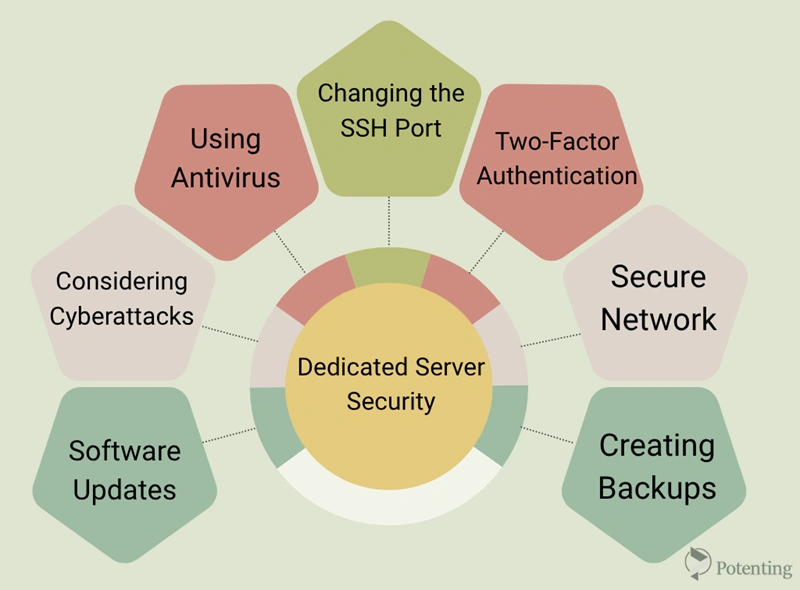
The most important ways to improve the security and stability of a dedicated server include:
Updating and Keeping Software Up to Date
This may seem unimportant, and you might think that you do not necessarily need to install software updates on the same day they are released. However, this is not the case. Timely updates and regularly updating software and operating systems can significantly improve server security. Updates fix identified vulnerabilities in software, preventing hackers from exploiting them to harm the system.
It is better to automate updates so that they can be performed without any problems. However, updates are not limited to software, and you should also consider the hardware. Always keep your hardware in good condition and up to date to prevent disruptions as much as possible.
Considering Cyberattacks
As mentioned above, hardware should be up to date and in good condition. You might wonder why this matters, since hackers cannot directly damage hardware. However, they can put your hardware under pressure remotely and cause damage. How? Through various cyberattacks, such as DDoS attacks.
Your hardware must be in good condition to maintain its stability during DDoS attacks. At the same time, firewalls and other protective mechanisms must be able to withstand these attacks. There are various measures you can take to identify and prevent these types of threats.
Using Antivirus Software
Identifying and removing malicious software is important. This can be addressed by using reputable antivirus software, running malware scans, and taking similar measures. If you are concerned about the impact of these scans on server traffic and performance, you can schedule them for periods when the server has the least traffic.
Security software offers a variety of features, and advanced tools can remove malicious software when it is detected.
Changing the Default SSH Port
When you install an operating system on a dedicated server, SSH uses its default port, which is port 22. To help prevent threats and attacks, it is better to change this port to a randomly selected number. Another important consideration is restricting user access to the server. Users should only have the level of access they need.
Using Two-Factor Authentication
Adding another layer of security alongside a password significantly improves server security. In this situation, even if an attacker gains unauthorized access to the password, accessing the server will still be more difficult.
Using a Secure Network
Always make sure to use secure connections when connecting to your server, and it is better to avoid public networks. If you must use a public network, use a VPN to encrypt your traffic. This point is particularly important because it helps prevent threats such as man-in-the-middle attacks, data interception, and similar risks.
Creating Backups
None of these measures can guarantee 100% server security. Therefore, make sure to create regular backups so that if unauthorized access occurs or your data is deleted for any other reason, you have a copy available and your efforts are not lost.
Data loss does not occur only because of cyberattacks. It can also result from hardware failures, database problems, and other issues. Therefore, take backups seriously.
How Can You Improve Server Security?
Not everyone who needs a dedicated server has extensive specialized or technical knowledge in this area, and it cannot be assumed that everyone can implement server defense and security measures effectively. Ensuring security is a complex task that cannot be ignored due to its importance. In this situation, a managed dedicated server is one of the best options.
With a managed dedicated server, the provider is responsible for managing and securing the server, so users no longer need to worry about this aspect. However, when choosing this service, the provider you select is also very important. You should make sure that the provider remains committed to the stated goals.
Ultimately: What Should You Consider When Choosing a Secure Managed Dedicated Server?
When choosing a managed dedicated server, you should evaluate the provider’s security measures, monitoring services, update management, backup policies, and incident response procedures. It is also important to clarify which security responsibilities are handled by the provider and which remain the customer’s responsibility. Make sure the provider offers clear service-level agreements (SLAs), reliable technical support, and transparent policies for handling security incidents.
FAQ
1. What Are the Types of DDoS Protection?
Network-layer DDoS protection blocks attacks that overwhelm network bandwidth and infrastructure with large volumes of traffic. Application-layer protection targets attacks that exhaust server resources by sending large numbers of HTTP requests. Tools such as WAFs and rate limiting help mitigate these attacks.
Using both methods improves dedicated server security and service availability.
2. What Is the Difference Between IDS and IPS?
An Intrusion Detection System (IDS) monitors network traffic and server activity to identify suspicious behavior and potential attacks. When a threat is detected, it alerts the server administrator. In contrast, an Intrusion Prevention System (IPS) can take automatic actions, such as blocking malicious traffic, in addition to detecting threats. Using these two systems alongside other security measures can help identify threats more quickly and reduce the risk of unauthorized access to a dedicated server.