When you enter a website, how long are you willing to wait for a page to load? Statistics show that if a website’s loading time reaches 3 seconds, about 53% of users will leave it. This statistic clearly demonstrates how significantly loading speed can affect the success of a website. In addition to increasing the bounce rate, a slow website also impacts user experience and can increase the user drop-off rate, reducing users’ trust.
What is website speed?
Imagine you go to a restaurant. To decide whether you will choose this restaurant again, you consider several factors—for example, the environment, the staff’s behavior, the quality of the food, and so on. Now suppose all of these aspects are of the highest quality, but it takes about 2 hours for your food to be prepared. In this situation, would you choose this restaurant again? It is unlikely.
Now think of a website instead of a restaurant. Imagine you enter a website that offers high-quality services, but to use those services you have to wait a long time for the website to load. (This is extremely frustrating.)
Website speed is the amount of time it takes for a browser to fully load a web page. If your website is slow, the user may not even realize it, because they leave the site as soon as they notice the delay.
Challenges of a slow website
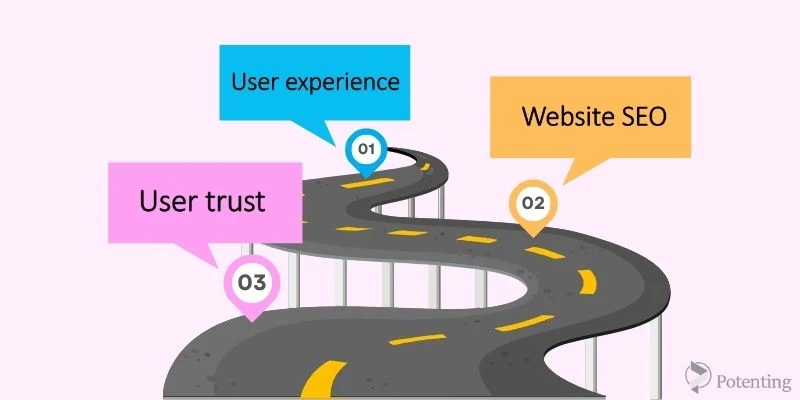
Some of the most important problems caused by slowness include the following:
User trust and conversion rate
Various studies and research have shown that the higher a website’s speed, the higher its conversion rate. In general, users trust fast websites more and prefer to stay on them.
Website SEO (Search Engine Optimization)
Google considers speed just as important as quality and reliability. One of the most important ranking factors for websites is their speed. Therefore, if your website has a low loading speed, it will rank lower in Google search results.
User experience
If you provide a good user experience, the two factors mentioned above—your SEO ranking and conversion rate—will also improve. However, with a slow website, this is somewhat unlikely. The most important step in creating a user experience is website speed.
Ways to improve website speed
After understanding how much website speed can affect a site’s success, let’s move on to the solutions and actions that can help improve it.
Page size
If you have knowledge of website development, you probably know how important optimized code is. The presence of video files, large JavaScript files, an accumulation of images, unoptimized CSS files, and so on can increase the website’s weight and make loading time-consuming. One of the major challenges for developers is optimizing this issue.
To better understand this, consider the following example: you order a plate of pasta for one person in a restaurant, but it takes two hours to be prepared. Why? Because the chef prepared pasta for 10 people at once. When website files are not compressed, the same thing happens.
Custom fonts
The restaurant that took the pasta order does not have a suitable dish to serve it and only thinks about buying one after receiving the order. Using a custom font that is not optimized for a website can slow down the browser, because it has to download the font.
You have probably entered a website where the text is first displayed in a default font, and then the custom font loads later, which takes time to render properly. To prevent users from experiencing this issue, fonts must be optimized and properly implemented in web pages.
Unnecessary JavaScript
JavaScript is essential for building a website, but loading it where it is not needed can slow down page loading. The presence of unnecessary JavaScript files can cause two main problems:
- Downloading these files can be problematic when their size is large.
- If unnecessary code is executed, the browser has to process it, which takes time.
Server issues
Website slowness is not only related to development; in many cases, it can be caused by infrastructure and resource limitations. As website traffic and the number of visitors increase, server resources must also scale up so that server-side processing can be handled properly and in a short amount of time.
For example, imagine your restaurant has 100 customers, but it only has the capacity to serve 50 people. This causes some customers to wait in line, while others may give up and leave.
Increasing server resources based on the website’s needs and using a Content Delivery Network (CDN) are solutions to this problem.
Hosting location
Imagine your restaurant also offers delivery. A customer from a distant area places an order, but by the time the food reaches them, it has become cold and low quality. To solve this problem, it is better for your restaurant to be located closer to your customers.
The same applies to web hosting. When the hosting location is far from your target audience and website users, network latency occurs. To provide a better user experience and reduce delays, it is better for your hosting to be as close as possible to your users.
Lack of caching
Cache is a short-term memory where frequently used data is stored. When a user requests that data again, it is retrieved from the cache, which increases loading speed. It is recommended to use this feature so that users can access commonly used content more quickly.
🚀 Boost Your Website Speed Instantly
A slow website loses visitors and rankings. With a powerful web hosting solution, your site loads faster, performs better, and delivers a smoother user experience.
Upgrade to premium hosting and unlock maximum performance for your website today.
🔥Buy Web HostingHow to measure website speed?
There are various tools available to test website speed that you can use. In addition to measuring speed and performance, these tools can also identify the causes of slowness. For example, they can tell you which page is causing your website to slow down.
Finally
In conclusion, website speed is one of the most important factors for success in the digital world, as it directly affects user experience, conversion rates, and a website’s ranking in search engine results. Even if a website offers high-quality content and services, a slow loading speed can still cause it to lose a significant number of users. Therefore, optimizing factors such as page size, proper use of fonts, reducing unnecessary JavaScript, improving server performance, choosing suitable hosting, and using caching can play a crucial role in enhancing website performance. As a result, paying attention to website speed is not an option, but a necessity for success in the competitive online environment.
FAQ
1. What is website speed?
Website speed refers to the amount of time it takes for a web page to fully load in a browser.
2. Does hosting affect website speed?
Yes, the quality and location of the hosting server play an important role in page loading speed.