Nowadays, most businesses need servers and network infrastructure, but do they also have server storage space?
According to surveys, the answer for most users is no. Maintaining servers and network hardware requires infrastructure that is not easy to provide. In this context, the use of colocation becomes important.
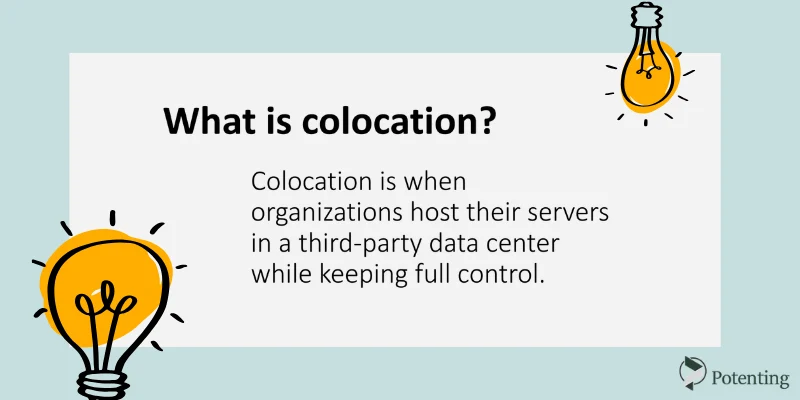
What is colocation?
In colocation, you place your servers and hardware equipment in a data center. In other words, you have a server that you want to keep in a standard environment. At this point, you rent space in a data center from a colocation provider, and your server is placed there.
If we want to compare this to making pizza, it would be like this: you go to the market and buy the ingredients for pizza, mix them, and prepare the pizza. But you don’t have an oven to bake it, so you go to a restaurant and give them your pizza so they can bake it for you.
In data centers, physical space and server cooling equipment are built to be standardized and designed for maximum efficiency. By using colocation, organizations, instead of placing their equipment in a simple server room, put it in a standard environment, which increases efficiency. Even though your servers are located outside your organization, ownership and full management of them still remain with you.
Why should colocation be used?
The cost of building infrastructure to maintain network equipment, especially servers, is very high. This equipment requires cooling, stable power, security, and more. In addition, building a facility with these features is quite difficult. However, data centers are built to provide these capabilities.
Organizations using colocation pay a monthly fee to the data center. In return, the data center provides stable power, secure physical access, standardized cooling systems, and other facilities, creating conditions that allow you to achieve the highest efficiency from your network infrastructure.
Advantages of using colocation
- Connectivity and scalability: There is stable and powerful network connectivity in data centers, and colocation providers are connected to cloud service providers. As a result, data transfer is very fast and secure.
- Cost reduction: By using colocation, organizations only pay for the maintenance of the infrastructure. Without it, they would have to cover the costs of building a data center, hiring engineers and specialists to maintain the infrastructure, as well as other additional expenses, which is not cost-effective.
Which organizations need colocation?
- Organizations that require performance-sensitive workloads.
- Financial institutions whose infrastructure must comply with auditing standards.
- Service providers that are seeking the lowest possible latency.
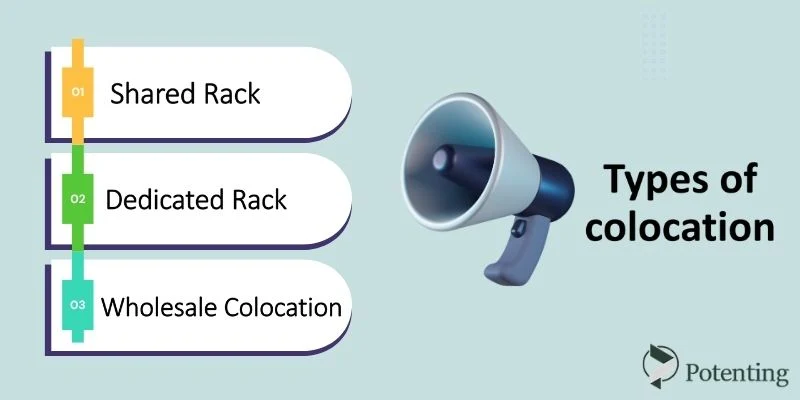
Types of colocation
Data centers offer different types of colocation to meet various needs.
Shared Rack
Multiple servers can be placed in a single rack. In a shared rack, several customers place their servers within the same rack. This type of colocation is cost-effective and suitable for businesses with low power consumption needs.
Dedicated Rack
This type of colocation is designed for large companies and organizations, as the entire rack space is allocated to a single customer. A dedicated rack increases data security and provides greater independence to the organization. It is recommended for organizations that require custom configurations and equipment management.
Wholesale Colocation
Some organizations find that even a dedicated server and rack are not sufficient. In such cases, they require wholesale colocation. With this type, a custom room or environment with a specified number of racks is allocated to them.
Choosing a colocation data center
Key factors to consider when selecting a suitable colocation service include:
Geographical location
To reduce latency and improve data access, it is better for the infrastructure to be located geographically close to the organization or its users. This improves network performance and also makes it easier to comply with local regulations.
Scalability
Choose a data center that is scalable and can provide the necessary resources and space as your business grows.
High security
The most important factor in data centers is security. Both physical and software security must be ensured to minimize risks and potential threats.
Finally
Colocation is a practical and cost-effective solution for organizations that require a stable, secure, and scalable infrastructure but do not want to bear the cost and complexity of building and maintaining a dedicated data center. By using this service, businesses can focus more on developing their services and growing their operations, while their physical and technical infrastructure is managed in a standardized and professional environment. Choosing the right data center and type of colocation can play an important role in improving efficiency, reducing costs, and enhancing the end-user experience.
FAQ
1. Is colocation secure?
Yes, professional data centers use advanced physical and software security systems such as access control, surveillance cameras, and firewalls.
2. What is the difference between colocation and hosting?
In hosting, the servers belong to the service provider, whereas in colocation, the hardware belongs to you, and you only rent space in the data center.
3. Which types of businesses need colocation?
Large organizations, financial institutions, online service providers, and businesses that require high speed and low latency.