Successful and large enterprises approach every expense with careful calculation and planning. For them, price and quality always go hand in hand, and they constantly seek the best possible options. Hosting is one of those critical areas that, without proper planning and evaluation, can result in substantial costs. However, making the right choice can reduce these expenses by up to half.
Colocation is a hosting method without fixed or rigid pricing rules; nevertheless, several factors can significantly influence its final cost.
Factors Influencing Colocation Pricing
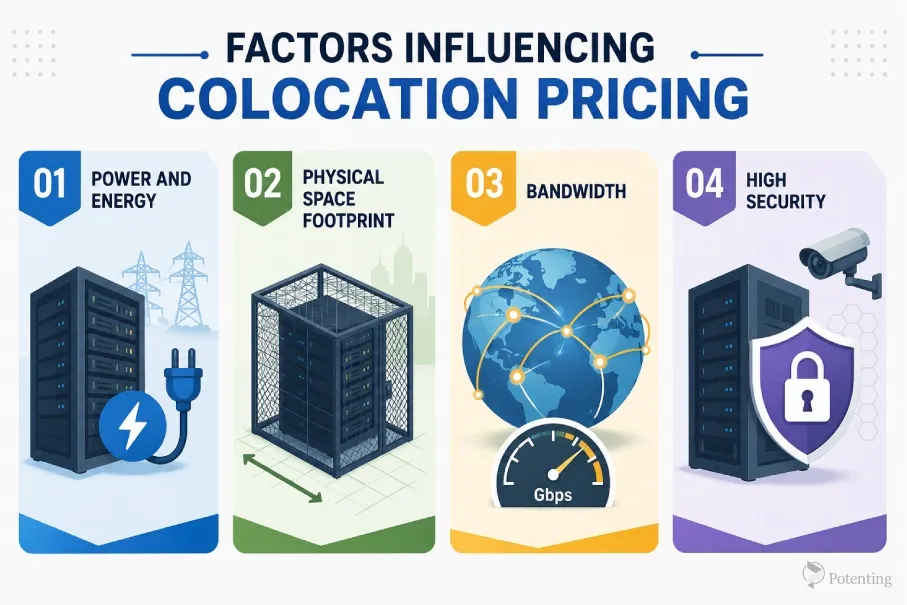
Every business has unique requirements, which is why colocation pricing is not fixed. Below, we examine the factors that affect the cost. Generally, four key elements play a decisive role in colocation pricing:
Power and Energy
As you know, ensuring a stable power supply is one of the core requirements of any data center. Servers require uninterrupted electricity to remain active and available 24/7. A data center houses numerous servers that consume substantial amounts of power; additionally, cooling systems require significant energy to operate. This makes power and electricity one of the largest operational expenses for data centers.
However, power costs depend on several factors, including data center size, power sources, and geographic location. Most data centers factor in both primary and backup power sources when calculating energy fees. While you can choose a data center in a region with lower electricity rates or select a provider that does not charge extra for backup power to reduce colocation costs, caution is necessary.
A country with cheap electricity may lack grid stability and suffer from frequent power outages. Similarly, a low-cost data center might lack reliable backup power sources, leaving your servers vulnerable to downtime during power failures. This can cause damage far beyond simple downtime, potentially leading to hardware failure. Therefore, cost should not be the sole deciding factor—quality and reliability are equally critical. Before selecting a colocation provider, carefully review the data center’s history of outages and power stability.
Physical Space Footprint
In data centers, colocation costs are strongly tied to the amount of physical space your equipment occupies. Total expenses vary depending on whether you lease a single rack, a dedicated cage, or a private suite. Rack space can be ordered as either a partial rack or a full rack. Full racks are lockable, dedicated enclosures capable of housing multiple servers, while partial racks feature a shared configuration, making them a cost-effective option for smaller businesses with minimal hardware. Dedicated cages and private suites, on the other hand, provide expansive, secured environments capable of housing extensive server infrastructure and network hardware. Naturally, as your physical footprint expands, colocation service fees scale accordingly.
Geographic location also plays a critical role in footprint pricing. For instance, the cost of a private suite can vary significantly between two different data centers. Facilities located near major urban centers or metropolitan areas command higher rates due to inflated real estate values and operating costs. For businesses where low latency and high network performance are paramount, proximity to the end-user base is essential—even if it entails higher real estate and energy costs.
Bandwidth
Bandwidth refers to the maximum data transfer capacity between your servers and various external networks. Higher bandwidth allows a larger volume of data to be transmitted within a given timeframe, making it critical for high-traffic businesses, data-intensive applications, and multi-cloud environments. In colocation facilities, key factors such as connection speed, bandwidth exclusivity (dedicated vs. shared), network latency, and carrier-neutral connectivity directly impact both network quality and overall service costs.
High Security
The level of security provided is a key factor that can drive up colocation costs. However, security is a paramount priority, and most businesses are ready to invest significantly to ensure their data and hardware remain protected. Indeed, enhanced security infrastructure is one of the primary reasons organizations choose colocation services over managing their own hardware. If a colocation facility offers robust, high-grade security, compromising on quality or switching to a cheaper alternative merely to reduce expenses is unadvisable—security is the single most critical feature of any enterprise data center.
Additionally, ensuring that the data center is located away from areas prone to natural disasters—such as floods and earthquakes—is of critical importance. When selecting a colocation provider, be sure to pay special attention to this factor.
If security is a top priority for you, I recommend using Potenting’s colocation services to enjoy both affordable pricing and high security.
Key Factors to Consider in Colocation Costs
While cost reduction and budget optimization are vital for business growth, financial savings should never come at the expense of long-term stability. Colocation and hosting infrastructure directly impact business continuity and operational efficiency; therefore, evaluating service quality alongside pricing is critical. For instance, a low-cost option may seem appealing initially, but poor uptime, inadequate physical security, or sub-par network infrastructure can lead to substantial long-term losses. Cost efficiency matters, but it remains a sound decision only when it does not compromise security, reliability, and business performance.
Finally: How to Reduce Colocation Costs?
- Prioritize Geographic Location: Select facilities in naturally cooler climates. Lower ambient temperatures reduce reliance on power-heavy cooling systems, significantly cutting energy expenses.
- Consider Suburban or Off-Site Facilities: If your operations do not strictly require ultra-low latency or real-time processing, opting for a data center outside major urban centers can yield substantial savings on real estate and power tariffs.
- Opt for Large-Scale Data Centers: Large facilities utilize optimized, state-of-the-art power distribution and cooling infrastructure. Their economy of scale and energy efficiency translate directly into lower operational costs for clients.
FAQ
1. What is the difference between a full rack and a partial rack?
A full rack provides a dedicated, lockable enclosure for businesses with multiple servers. A partial rack is a shared configuration, offering a cost-effective option for smaller entities with limited hardware.
2. Why are backup power sources (UPS and generators) essential in a data center?
Sudden power outages can cause data loss and physical hardware damage. Backup power systems ensure servers remain operational without interruption, even during municipal power grid failures.