Imagine that your website has grown significantly and is now receiving much more traffic than before. At this point, shared hosting may no longer be able to meet your performance requirements. Limited resources and reduced stability can lead to slower loading times and a poor user experience, leaving your visitors dissatisfied.
On the other hand, your website may not yet be large enough to justify investing in a dedicated server, especially when doing so would consume a significant portion of your monthly budget.
In this situation, a Virtual Private Server (VPS) is the ideal solution, offering the perfect balance between performance, flexibility, and cost. However, the advantages of a VPS extend far beyond website hosting alone.
Introduction to VPS and Its Features
A physical server can be divided into multiple virtual servers using virtualization technology. Each virtual server is allocated its own dedicated hardware resources and operates in a completely isolated environment.
In other words, a Virtual Private Server (VPS) is a physical server shared among multiple users, similar to shared hosting. However, unlike shared hosting, each VPS has its own isolated resources, providing a level of performance and control that closely resembles a dedicated server.
A VPS offers many advantages, including enhanced security, scalability, cost-effectiveness, full administrative access, and flexible management capabilities, making it a popular choice for businesses, developers, and website owners.
Launch Your VPS in Seconds
High-performance VPS hosting with NVMe storage, global locations, full root access, and enterprise-level protection.
Who Is a VPS Suitable For?
In this section, we’ll explore the most common use cases of a Virtual Private Server (VPS) and see who can benefit the most from using one.
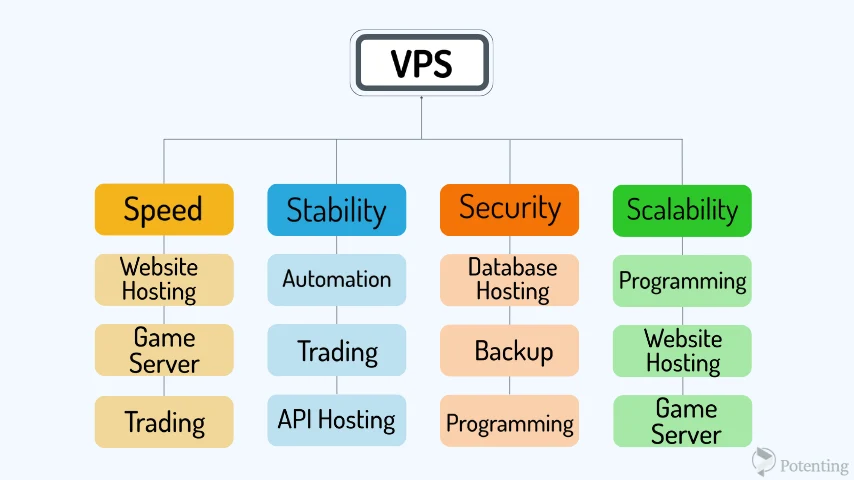
Website Hosting
As mentioned earlier, a VPS is an excellent choice for hosting medium to high-traffic websites. Dedicated resources, high performance, and reliable uptime help websites load faster and remain stable even during traffic spikes. In addition, the ability to install custom software, configure the server environment, and upgrade resources whenever needed makes VPS hosting an ideal solution for website owners.
Game Server Hosting
Many online games require powerful hardware resources and a stable connection to deliver a smooth multiplayer experience. With a VPS, users can host their own game servers without investing in expensive hardware. Isolated resources, low latency, high availability, and the flexibility to scale resources provide a better gaming experience. VPS is also a popular choice for game developers who need to test and manage multiplayer environments.
Software Development and Programming
A VPS is one of the most popular solutions for developers and software teams. It allows them to create isolated development environments, test applications, deploy projects, and run databases without affecting their local systems. Root or Administrator access, along with the ability to install any required software and fully customize the operating system, gives developers maximum flexibility. VPS is also widely used for CI/CD pipelines, Docker containers, and API testing.
Trading and Financial Automation
Traders rely heavily on speed, stability, and uninterrupted connectivity. Even a few seconds of downtime or network latency can result in missed trading opportunities or financial losses. A VPS provides a stable, always-on environment with low latency, making it ideal for running trading bots, MetaTrader Expert Advisors (EAs), and other automated trading systems. Since the server operates 24/7, trading strategies continue running even when the user’s personal computer is turned off.
Application and API Hosting
Many developers use VPS hosting to deploy web applications, backend services, and APIs. Dedicated resources, complete control over the server environment, and support for various programming frameworks ensure stable performance and faster response times. As application traffic increases, server resources can be upgraded without migrating to a new hosting environment.
Database Hosting
If your application or website relies on a database, a VPS provides the performance and flexibility needed to manage it efficiently. It supports popular database systems such as MySQL, PostgreSQL, MariaDB, and MongoDB while allowing administrators to configure them based on specific performance and security requirements.
Running Bots and Automation
A VPS is commonly used to run Telegram bots, Discord bots, social media automation tools, scheduled scripts, web crawlers, and other automation services. Since the server remains online around the clock, these applications continue running without interruption and do not depend on the user’s personal computer.
Private VPN Server
Many users choose a VPS to build their own private VPN server. Unlike public VPN services, a self-hosted VPN offers greater privacy, improved security, and better performance because only authorized users have access to the server.
Backup and File Storage
A VPS can also serve as a secure backup and file storage solution. Businesses and individuals often use it to automatically back up websites, databases, and important files. In the event of data loss or system failure, backups can be restored quickly, helping to minimize downtime and protect critical information.
Finally
A VPS offers a wide range of features, making it a highly versatile solution for many different use cases. Individuals and businesses across various industries can take advantage of a Virtual Private Server to improve performance, efficiency, and reliability. Depending on your specific requirements, you can choose a VPS configuration with the operating system and hardware resources that best suit your workload.
Whether you need a fast and reliable hosting environment for your website, powerful hardware resources for game hosting, a scalable development environment for programming, or a stable platform for automated trading, a VPS provides a cost-effective solution without compromising on performance.
However, choosing the right VPS provider is just as important as selecting the server itself. The quality of the infrastructure, network, hardware, technical support, and uptime guarantees all have a significant impact on the overall performance and reliability of your VPS.
FAQ
1. When should I migrate from shared hosting to a VPS?
When your website has grown, traffic has increased, your website speed has decreased, or you are facing resource limitations with shared hosting, a VPS can be a suitable solution to improve performance and stability.
2. Do I have full access to the server with a VPS?
Yes. Most VPS services provide Root access on Linux or Administrator access on Windows, allowing you to install software, modify server configurations, and fully customize your server environment.
3. Why is VPS a cost-effective choice?
A VPS provides the perfect balance between cost and performance. Without paying the high price of a dedicated server, you can access dedicated resources, full control, and advanced features.