Since servers possess immense power and resources that most individual users do not fully require, their capacity is divided among multiple users in various ways, known as Virtual Private Servers (VPS) and shared hosting. However, there are scenarios where users require a full server with all its resources dedicated entirely to them; in such cases, they need to acquire a dedicated server.
When Do You Need a Dedicated Server?
With the rapid evolution of the hosting industry and increasing server demands, various types of hosting solutions were developed to cover every requirement. One such solution is the dedicated server. Many who imagine they need a dedicated server actually do not, while conversely, many who think they do not need one actually require it. Let’s take a closer look at these cases.
For consultation regarding the purchase of a dedicated server, you can also get in touch with Potenting’s experts.
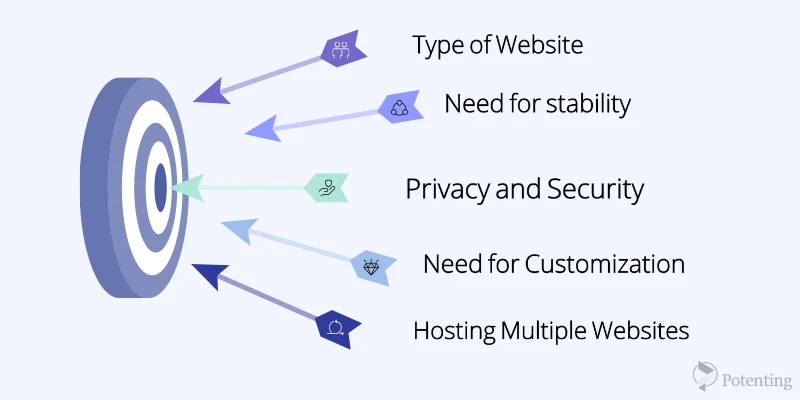
Type of Website
Websites must determine the right type of hosting based on their specific nature. For instance, shared hosting is sufficient for a simple blog; even if it receives high traffic, it does not demand heavy resources because its database usage and background processing are minimal. Similarly, a small e-commerce website with a limited product catalog can comfortably run on a VPS.
But is this also true for a high-volume banking web application or a large enterprise e-commerce platform? No. For these types of sites, purchasing a dedicated server with fully dedicated resources is strongly recommended, as they involve high traffic, extensive database queries, and heavy processing workloads.
High Traffic and the Need for Stability
When a business launches, it typically starts with shared hosting due to low traffic and minimal resource consumption. As the business grows and visitor numbers increase, it migrates to a VPS to accommodate higher resource demands. Ultimately, when VPS resources are no longer sufficient—causing the site to experience slowdowns and instability—it becomes necessary to transition to a dedicated server. This transition is a clear positive indicator of a growing, expanding business.
Dedicated servers offer high stability, making them ideal for high-traffic platforms, such as major e-commerce stores and businesses that experience sudden traffic surges during specific promotional events or peak periods.
Privacy and Security
In some cases, you may not necessarily have huge data volumes or massive traffic to justify a dedicated server, and standard hosting might technically cover your resource needs. So why purchase a dedicated server? Because you require maximum security. While shared hosting may lack top-tier security, you might assume that a VPS provides sufficient protection and that a dedicated server is unnecessary.
The crucial point here is that in a VPS environment, hypervisor-level security vulnerabilities can potentially exist. On a dedicated server, however, since the entire physical server and all its resources are exclusively yours, those shared virtualization security risks are eliminated.
Need for Customization
Specialized workloads, custom modules, or specific operating system configurations: if your setup requires any of these, a VPS provider might not support them. Generally speaking, to achieve deep, low-level customization over your environment, you need a dedicated server. With a dedicated server, you have direct root/hardware-level access, giving you full control over the operating system, kernel, drivers, hardware resources, and custom configurations without the limitations typically imposed by virtualization.
Hosting Multiple Websites
If you are a large organization managing multiple hosting environments and servers, it is often better to acquire a single dedicated server and consolidate your operations. This approach reduces overall infrastructure costs compared to maintaining multiple separate server instances.
Finally: Who Truly Needs a Dedicated Server?
As outlined above, most businesses do not immediately require a dedicated server; in most scenarios, a well-configured VPS will meet your needs. However, if you encounter factors such as heavy traffic, strict uptime requirements, advanced security demands, or complex customization needs, a dedicated server is the appropriate choice.
For example, imagine running a banking web application and a simple personal blog on the same server… It would be completely illogical to compromise the stringent security and dedicated resources of a critical financial platform by mixing it with a lightweight, low-priority site. Each workload demands an environment tailored to its specific scale, security, and operational needs.
FAQ
1. Does a dedicated server offer better security than a VPS?
A dedicated server can provide greater control and isolation because its resources and hardware are not shared with other users.
2. What is the advantage of a dedicated server for companies managing multiple websites?
Large organizations can consolidate all their hosting environments onto a single dedicated server instead of purchasing and managing multiple separate servers, significantly reducing infrastructure costs.