After starting a business, one of the challenges you will face is choosing the right hosting solution. If your business started with shared hosting and you have witnessed its growth and progress, you have probably faced challenges in choosing the right hosting solution over time. If you are on this page now, it means your business needs either dedicated server hosting or colocation, and you are looking for the right option between the two.
You should know that both dedicated servers and colocation are suitable for large businesses with high security requirements. But which one should you choose? Making the wrong choice at this stage can lead to major problems, including high, unexpected costs, operational bottlenecks, performance challenges, and significant losses for the organization as a whole.
Understanding Colocation
With all hosting types, you are essentially renting something. With shared hosting, you rent resources; with a virtual server, you rent a portion of a server; and with a dedicated server, you rent an entire server. Of course, colocation is also a form of renting. With colocation, you rent space in a data center to house your own server. In other words, you own the server, but you place it in a facility and pay rent for the space.
Along with providing space, the data center offers power, cooling systems, security systems, network connections, and everything a server needs to operate, remain connected, and be maintained.
To compare this model to something familiar, imagine a clothing store. You rent a shop equipped with all the necessary facilities, including clothing racks and everything else needed to run a clothing store. Finally, you place your merchandise inside the shop. Therefore, it is important to consider the shop’s location, the features and facilities it offers, and, ultimately, its ability to provide stability.
Understanding Dedicated Servers
A dedicated server is also a type of hosting in which you rent a server from a provider. The provider owns the server, but you rent the entire physical server, along with its network infrastructure, for your business. The server and all its processing power are dedicated to you. With this model, you benefit from greater security because no other users share your server, and you have more freedom to implement features such as customization.
However, unlike colocation, you will not be responsible for the server itself or hardware management.
Dedicated Server or Colocation
By now, you should be familiar with these two hosting options. But let’s take a closer look at their differences.
Common Business Use Cases
- Colocation: This type of hosting is suitable for businesses that require multiple servers, specialized hardware architecture, high security, and low latency. Financial institutions, trading platforms, and healthcare organizations are among those that can benefit from this approach.
- Dedicated Server: This type of hosting is suitable for growing digital agencies, e-commerce platforms, software developers, and businesses that need dedicated resources, stable performance, and high security but do not want to take responsibility for purchasing and maintaining hardware.
Hardware Ownership
- Colocation: In this model, you own the server and hardware equipment. Therefore, you are responsible for repairs, replacing faulty components, and upgrading equipment. However, by choosing managed colocation services, you can delegate some of these responsibilities to the service provider.
- Dedicated Server: With this type of hosting, you do not own the hardware, and the provider is generally responsible for physical maintenance, repairs, and replacing faulty components. However, the exact scope of these services depends on the contract and the level of support offered by the hosting provider.
Hardware Control and Customization
- Colocation: You have greater control over component selection, hardware upgrades, BIOS and firmware settings, and server configuration. This is particularly important for businesses that require a specific hardware architecture.
- Dedicated Server: Hardware selection is generally limited to the configurations and options offered by the hosting provider. However, some providers also allow you to customize server specifications.
Setup and Maintenance
- Colocation: To set up a server, you must acquire the equipment, transport it to the data center, and install it in the rack space. You may also need to visit the data center or use technician services for physical repairs or component replacements.
- Dedicated Server: The provider sets up the server in its own data center and gives you the necessary access. As a result, you can focus on deploying your required software and services without having to manage the physical equipment.
Comparing Dedicated Servers and Colocation
| Criteria | Colocation | Dedicated Server |
|---|---|---|
| Server Ownership | Owned by you | Owned by the provider |
| Hosting Type | Renting data center space | Renting a physical server |
| Initial Cost | High; hardware purchase required | No server purchase required |
| Hosting Cost | Rack space, power, and bandwidth | Server rental |
| Hardware Control | Full control | Limited to the provider's offerings |
| Customization | Extensive | Depends on the provider |
| Repair and Maintenance | Your responsibility | Usually the provider's responsibility |
| Setup | Your responsibility | Provider's responsibility |
| Security | Greater control over hardware | Dedicated resources |
| Scalability | Depends on data center capacity | Depends on the provider's offerings |
| Need for Specialists | High | Lower |
| Suitable For | Large organizations and specialized requirements | Online stores and growing businesses |
Comparing the Costs of Colocation and Dedicated Servers
You might assume that colocation is significantly cheaper than a dedicated server. Let’s take a closer look. Renting a dedicated server from a provider starts at $91 and can cost up to $100. However, with colocation, the cost of purchasing server hardware can range from $400 to $15,000, depending on the server model.
Colocation and bandwidth costs also start at $100 with a provider. Even with a rough calculation, it is easy to see that purchasing a server and using colocation can be more expensive, even before accounting for maintenance costs and hardware issues. Therefore, this model is not cost-effective or economical for every business.
When Is Colocation the Best Choice?
- You need specialized hardware. For example, if you need a custom configuration, hardware security modules, or a specific network card, colocation may be the only and best option. The server belongs to you, and you can make any changes you want to its hardware.
- You need a large number of servers and operate them at scale. Even when you have many servers, providers often offer significant discounts.
- You have an extensive operations team and specialists in the field to handle colocation maintenance and servicing tasks.
- You operate in a sensitive organization or certain government-related businesses. These organizations may require processing to take place on personally owned servers to ensure complete privacy.
Looking for a Reliable Colocation Solution?
Find the right colocation solution for your business with reliable infrastructure, flexible options, and professional support.
Explore Colocation ServicesWhat Should You Consider When Choosing Colocation?
If colocation is suitable for your business and you plan to use this hosting solution, keep in mind that location is more important than ever. Imagine that your server develops a problem or one of its hardware components fails. If the data center is geographically far away, sending a company technician to the site will take a considerable amount of time and incur significant costs.
You should also consider how equipment will be shipped to the data center. Does the destination country have strict requirements regarding this process? How long will it take for the equipment to arrive at the data center? What are the associated additional costs? These are all important questions to consider.
Of course, location is not the only criterion for choosing a data center. Its security, infrastructure, and cooling systems are also important factors in making the right choice.
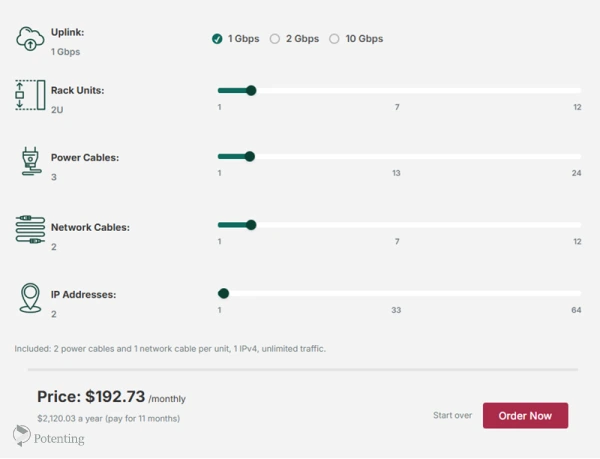
Another consideration is the scalability offered by the provider. Most providers impose limits on rack space, bandwidth, and IP addresses, which may not align with your needs. Flexibility is particularly important in colocation. For example, Potentting offers a feature that allows you to configure the services you need based on your requirements.
Conclusion
Choosing between a dedicated server and colocation depends on your budget, hardware requirements, and ability to manage infrastructure. A dedicated server is ideal if you need dedicated resources without handling hardware maintenance, while colocation is better if you want full hardware ownership and control. Ultimately, choose a solution that meets your current needs and supports your business as it grows.
FAQ
1. Is colocation cheaper than a dedicated server?
Not necessarily. Colocation requires an initial investment in hardware, along with ongoing costs for rack space, power, bandwidth, and maintenance.
2. Is colocation suitable for small businesses?
It can be, but the initial hardware investment and maintenance requirements may make it less practical for small businesses with limited budgets or technical resources.