To build a business in the online environment, the most important prerequisites are a domain and a host. It doesn’t matter whether your website is an online store, a blog, or a corporate site—either way, you will need a host.
But what is hosting? Why is it important? And how should you obtain it?
What is hosting?
To better understand the concept of hosting and how it works, we compare an online business with a physical (brick-and-mortar) business.
Imagine you want to set up a physical store. The first step is to choose a name for your store. In the online world, this name is called a domain. After that, you need a place to store your store’s products and equipment. In the online world, this place is called a hosting service.
In the real world, you rent a shop and place your goods inside it. Now imagine your store is 50 square meters, but 100 people visit it every day. In such a situation, overcrowding leads to customer dissatisfaction, and some of them may leave without making a purchase.
A similar situation exists in the online world. To run an online business, you need infrastructure that corresponds to the components of a physical store. The domain acts as the store’s address, and hosting service is the physical space of the store. In addition, you must choose your hosting resources according to the number of website visitors. If traffic exceeds the capacity and resources of the hosting service, the website’s speed will decrease and a poor user experience will be created for visitors.
How does web hosting work?
A host is a space on a physical server that you purchase from a provider. Depending on the provider, you can buy this space on a monthly or yearly basis. This physical server is running 24/7, allowing users to access your website at At any time of the day. This is where the importance of hosting service becomes clear.
User access to the website depends on proper hosting, as well as user experience and stability. Therefore, you must carefully choose it and its resources, selecting the right option based on your website’s needs.
Based on what has been explained, you might think that choosing a hosting service is difficult and requires technical knowledge, but don’t worry. Although, choosing a host is an important decision, it is not too difficult. The explanation follows.
How to choose hosting
Hosting services come in different types, including shared hosting, virtual private servers (VPS), dedicated servers, and more. Each of these are suitable for a specific type of websites.
Imagine you want to open a pharmacy. Can you open it in an industrial area? You can, but the growth and success it would have in a medical building would be much greater.
Online websites are the same. You need to choose the right type of hosting service so that your future growth is ensured. In addition, the resources you choose should be based on your website’s traffic and number of visitors.
Fast, Secure & Reliable Web Hosting
Launch your website with powerful cloud infrastructure, lightning-fast NVMe storage, and enterprise-grade security. Perfect for blogs, businesses, and online stores.
Choosing an appropriate hosting service
A server is like a computer, but with much more powerful resources and it operates 24/7. Servers have processors (CPUs) to handle different tasks, storage space for keeping data, bandwidth for the amount of data transferred at each moment, and RAM, which keeps frequently accessed data available.
These resources must be chosen correctly so that the website performs at its best.
If your business is small and newly established, your number of visitors is relatively low. So you can choose a hosting service with lower resources. However, you should pay attention to choose a scalable hosting service so that if your website traffic increases, you can upgrade your resources based on your needs.
How should you buy hosting?
Data centers have a large number of servers, which they rent out to hosting service providers. These providers then configure these servers and deliver them to customers.
There are many providers in this field, each one has its own procedures. Some features are essential and all providers must provide them, such as uptime and support.
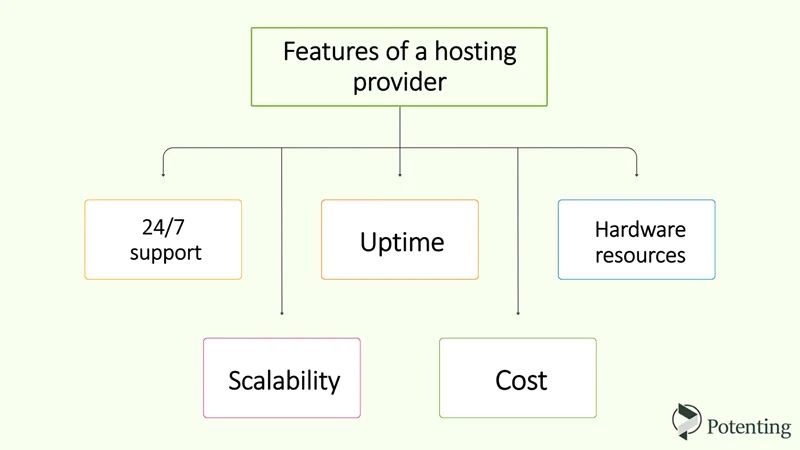
Just as choosing the right type of hosting service and its resources is important, selecting the provider is also important. A good provider should have the following features.
Uptime
High stability and constant availability of the website is important both for SEO and for creating a good user experience. Your hosting must have 99.9% uptime, and the provider must guarantee it.
24/7 support
A server is made up of hardwares, and it doesn’t matter how reliable it is, it may face issues at any time of the day. This is when responsive, 24-hour support becomes important, so that any disruption can be resolved in the shortest possible time.
Hardware resources
Providing servers with suitable and up-to-date hardware resources from standard data centers is important. Providing this will improve speed, security, and stability, and is of great importance.
Scalability
All businesses aim to grow and improve. Even if your website does not currently need many resources, that will not necessarily be the case in the future. Therefore, it is better to choose a hosting plan which is scalable, so you can increase or decrease the required resources as needed.
Cost
All the above features are important, and your chosen provider should have them, but the cost is also an important factor. The hosting provider should also offer reasonable prices for its plans.
Overview of different types of hosting
As mentioned, there are different types of hosting, each one with its own features and capabilities that makes it suitable for a specific type of websites. Here, we will get to know these hosting types in more detail.
| Feature | Shared Hosting | VPS | Dedicated Server | Cloud Hosting |
|---|---|---|---|---|
| Cost | Very low | Medium | High | Variable (based on usage) |
| Resources | Shared between users | Dedicated portion of a server | Fully dedicated | Distributed across multiple servers |
| Speed | Low to medium | Good | Very high | Very high and stable |
| Uptime (stability) | Medium | Good | Very high | Very high (almost no downtime) |
| Scalability | Weak | Good | Limited | Excellent |
| Security | Lower | Medium to good | Very high | Very high |
| Technical management | Simple (managed) | Requires technical knowledge | Requires high expertise | Requires medium to high technical knowledge |
| Suitable for | Small and beginner websites | Growing websites | Large and enterprise websites | Large projects and scalable applications |
Finally
In conclusion, choosing a hosting service is one of the most fundamental and critical decisions when starting and then scaling an online business. Just like a physical store cannot succeed without a suitable location, a website cannot perform well without a reliable and properly scaled hosting infrastructure.
Hosting service is not just about providing a simple storage space; but it is about forming the backbone of your website that determines its speed, security, stability, and overall user experience. Therefore, it should be chosen carefully based on the type of project, expected traffic, future goals, and budget.
If you are just starting out, there is no need to worry about technical complexity. The key is to make an informed decision while keeping scalability in mind. As your business grows, your required hosting infrastructures will grow.
If you have any questions about this topic, feel free to get in touch with us, consult our experts for more detailes and professional guidance.
FAQ
1. What is the difference between a domain and a host?
A domain is your website’s address (like the name of a store), while a host is the space where your website’s content is stored (like the physical location of a store).
2. Which type of hosting is suitable for beginners?
For new and small websites, shared hosting is usually the best option because it is more affordable and easier to manage.