A data center is the foundation of today’s digital infrastructure. Every website, cloud application, online service, and business system relies on data centers to store, process, and deliver information securely and efficiently. As organizations generate increasing amounts of data and adopt cloud computing and virtualization technologies, the role of data centers has become more important than ever. In this article, we’ll explain what a data center is, why it matters, its key components, and the different types of data centers used in modern IT environments.
What Is a Data Center?
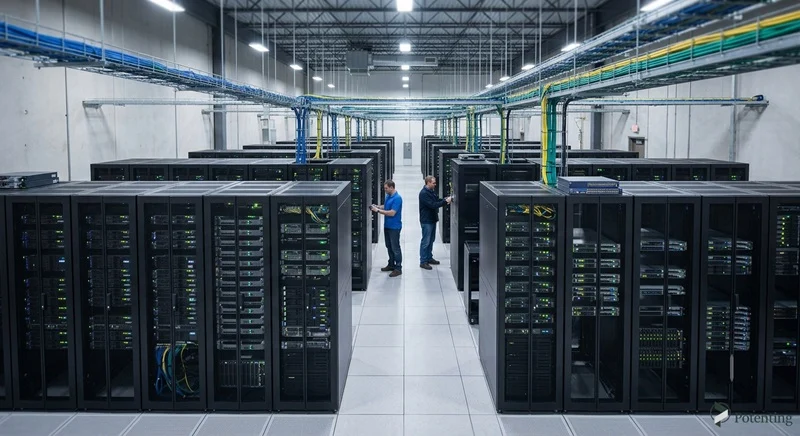
Servers and network equipment are highly sensitive and require special environmental conditions for proper operation and maintenance. These critical IT infrastructures are housed in a dedicated physical facility known as a data center.
At first glance, a data center may seem similar to an ordinary building, such as a house or an office. However, despite its outward appearance, the design, construction, and location of a data center must meet strict technical standards. These unique requirements make data centers essential for ensuring the security, reliability, and continuous operation of IT systems.
In the past, organizations typically maintained their IT equipment on their own premises, with each company operating its own dedicated infrastructure. However, this approach proved to be inefficient due to the significant investment required for infrastructure, as well as the complexity and cost of maintaining it. The development of remote facilities and professionally managed hosting services transformed this model, enabling organizations to outsource their infrastructure to specialized data centers.
What Is a Modern Data Center?
A modern data center is a facility that leverages advanced physical infrastructure alongside virtualization technologies to efficiently manage, process, and store data. Unlike traditional data centers, modern data centers are designed to provide greater flexibility, scalability, and operational efficiency.
Virtualization technologies enable organizations to distribute workloads and data seamlessly across multiple computing environments, including on-premises infrastructure, edge computing facilities, cloud platforms, and hybrid environments. This capability allows businesses to optimize resource utilization, improve performance, enhance availability, and respond more effectively to changing operational demands.
Why Are Data Centers Important?
Today, the internet and digital data have become an integral part of everyday life and modern business operations. Many online services, websites, and applications rely on continuous access to their data; without it, they are unable to function effectively.
This data is stored on servers, and when large numbers of servers are housed together in a secure, purpose-built environment, they form what is known as a data center. These servers are connected to the internet, allowing users and organizations to access their data and services from virtually anywhere.
As a result, data centers have become essential to the digital economy. Businesses of all sizes depend on them to store critical information, host websites and applications, run cloud-based services, and ensure the availability, security, and reliability of their IT infrastructure.
High-Performance Web Hosting Crafted for Speed
Now that you know how vital modern data centers are, power your own website with our ultra-fast, secure, and cloud-backed web hosting plans.
Core Components of a Data Center
A well-designed data center consists of several essential components that work together to ensure reliable, secure, and uninterrupted IT operations.
Servers and IT Infrastructure
A facility is considered a data center when it is equipped with the essential hardware and software required to support IT services. These components typically include servers, network switches, routers, firewalls, cybersecurity systems, storage devices, and other networking equipment.
Although the infrastructure of data centers may vary depending on their size and purpose, “servers” remain the core component of every data center, providing the computing power needed to process applications and manage data.
In addition to hardware, software plays a critical role in data center operations. Operating systems, virtualization platforms, network interface controllers (NICs), management software, and monitoring tools work together to optimize resource utilization, simplify administration, and ensure efficient service delivery.
Infrastructure Support Systems
Supporting infrastructure is vital to maintaining high availability and operational continuity. These systems help maximize uptime by preventing service interruptions, minimizing failures, and ensuring stable operation even during unexpected events.
Power infrastructure is among the most critical support systems in a data center. Power distribution units (PDUs), uninterruptible power supplies (UPS), backup generators, redundant electrical systems, and automatic transfer switches ensure that servers and networking equipment continue operating during power outages or electrical failures.
Additional support systems, such as cooling, environmental monitoring, and fire suppression, also contribute significantly to the overall reliability and efficiency of the data center.
Secure Data Storage
One of the defining characteristics of a reliable data center is its ability to store and protect data securely. For most organizations, data represents one of their most valuable assets, and data loss can lead to severe financial, operational, and reputational consequences.
Secure storage systems are designed to preserve the “confidentiality, integrity, and availability (CIA)” of data. They achieve this through technologies such as redundancy, backups, encryption, access control, disaster recovery mechanisms, and continuous monitoring, ensuring that business-critical information remains protected and accessible at all times.
Types of Data Centers
Data centers can be classified into several categories:
- Enterprise Data Centers: Built and operated by a single organization for its internal business operations.
- Colocation Data Centers: Organizations rent physical space, power, cooling, and connectivity while managing their own servers.
- Managed Data Centers: A third-party provider manages both the infrastructure and IT services on behalf of customers.
- Cloud Data Centers: Owned and operated by cloud service providers, offering computing resources over the internet.
- Edge Data Centers: Located closer to end users to reduce latency and improve application performance for real-time services.
- Hyperscale Data Centers: Massive facilities designed to support millions of users and cloud-scale applications with highly automated infrastructure.
Finally
Data centers form the backbone of today’s digital infrastructure. They provide the computing power, storage capacity, networking capabilities, and security required to support modern applications and online services.
As technologies such as cloud computing, artificial intelligence, the Internet of Things (IoT), and big data continue to evolve, the role of data centers will become even more critical. Organizations that invest in modern, resilient, and energy-efficient data centers will be better positioned to support future business growth, innovation, and digital transformation.
FAQ
1. What is the difference between a traditional and a modern data center?
Traditional data centers primarily rely on physical servers and on-premises infrastructure. Modern data centers incorporate virtualization, automation, cloud integration, and software-defined technologies to improve scalability, flexibility, resource utilization, and operational efficiency.
2. What is uptime in a data center?
Uptime refers to the amount of time a data center remains operational and available. High-quality data centers are designed to achieve uptime levels of 99.9% or higher through redundant power, cooling, and network infrastructure.