When you want to start a brick-and-mortar business, what factors do you consider? How important is the location of the business to you?
Choosing the right hosting location can be just as important. For online businesses, hosting is essentially the equivalent of the physical location of a brick-and-mortar business. There are several factors you should consider when choosing a geographic hosting location to ensure that you make the best choice for your business.
Why Is the Geographic Location of Hosting Important?
The geographic location of a data center can affect business performance, costs, user experience, compliance with regulations, and more.
Imagine that you run a brick-and-mortar clothing store located in an industrial area. Choosing the wrong geographic location for your hosting can be just as absurd—and, of course, damaging.
Factors Influencing the Choice of Business Location
To make the right choice, it is important to understand several factors related to web hosting.
Latency
The farther the hosting location is from your users, the higher the latency in processing and network communication will be. It is better to choose a hosting location that is as close as possible to your target audience. If your business provides services to a specific region or country, your hosting location should also be close to that region to minimize latency.
User Experience
Hosting location, latency, and user experience are closely connected. Research has shown that if users experience delays after clicking on a website, they may leave the site within the first two seconds. Even if users do not leave immediately, latency can reduce their satisfaction and result in a poor user experience. Therefore, choosing the right geographic hosting location is essential for providing a better user experience.
Power Availability and Energy Costs
Data center locations differ from one another, and as a result, their access to energy is not the same. In other words, different countries have different regulations and energy costs. When choosing a data center, you should consider the availability and cost of electricity in that location. This factor can have a significant impact on infrastructure costs and reliability.
When choosing a location, you should also make sure that the data center has sufficient scalability to meet increasing energy requirements in the future.
Cooling Systems
Data centers consume a significant amount of electricity, and a portion of this energy is used by cooling systems. Although various server cooling methods have been developed in recent years, many data centers still rely on traditional cooling methods and use fans. Many data centers are also built in geographic locations with cold and cool climates to reduce the need for air conditioning. This can help lower electricity consumption and reduce operating costs.
If a data center uses fan-based cooling, it is better to choose a location with a cold and cool climate. If it uses liquid cooling, you should make sure that there is sufficient access to water.
Legal Requirements
Every region and country has its own laws and regulations. If you choose a hosting service in a particular location, you must comply with the laws and regulations of that area. Take this issue seriously, as non-compliance can create legal and operational problems for your website.
Try to choose a data center located in an area whose laws and regulations you are familiar with and that, in general, do not conflict with the goals of your website.
Security
One of the most important factors—and potentially more important than any of the others—is security. The data center should be protected against various risks and threats, such as natural disasters and unauthorized access.
To assess this factor, check the local crime rate, evaluate the physical security of the data center, and avoid locations that are at high risk of events such as floods and earthquakes.
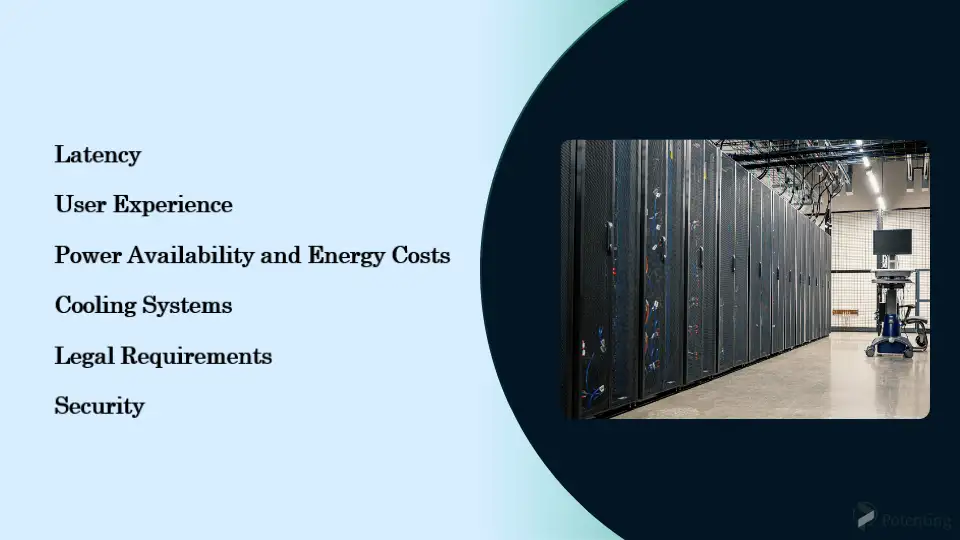
If you are looking for a hosting location that offers all of these features and can even exceed your expectations, consider Europe. Our recommendation is Netherlands hosting a country with powerful hardware, high-quality services, and extensive infrastructure that can provide ideal conditions for hosting your data and supporting your business. For more information and to choose the best option based on your needs, get in touch with our consultants.
Finally
In general, a data center should not be located in an area where it cannot meet its energy requirements or has limited access to clean energy. It should also not be exposed to natural disasters or flooding. In addition, insurance companies should not charge excessively high premiums for the location or refuse to provide coverage altogether.
It is important to understand that hosting does not simply store your business data. It supports and protects your business, its future, its growth, and more. Therefore, where your hosting is located matters.
FAQ
1. Why is security important when choosing a hosting location?
The data center should be protected against unauthorized access, natural disasters, flooding, and other physical threats. The security of the surrounding area and the facility itself should therefore be evaluated.
2. How does the cooling system affect the choice of data center location?
Cooling systems consume a significant amount of energy. Data centers in cooler climates may require less energy for cooling, while facilities using liquid cooling need reliable access to sufficient water resources.